
Psychiatry - General & Miscellaneous, Testing & Assessment - Psychology, Health Care Delivery, Mental Health Services & Personnel, Managed Care, Clinical Psychology - General & Miscellaneous
Log in to track your reading progress.
Overview
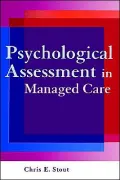
A combination reference, planning manual, and marketing guide, Psychological Assessment in Managed Care provides clinical psychologists with the expert guidance they need to successfully apply their unique psychometric and testing skills in the volatile world of managed behavioral health care. Clinicians and administrators alike will benefit from its detailed practical coverage of the new and emerging applications of both pencil-and-paper and automated psychological screening instruments. The book begins with a concise history of managed care, from the first HMOs to the emerging capitated payment systems. Special attention is given to the integration of mental and general health services, and the implications of this trend for psychological screening in medical settings. This is followed by an exploration of the benefits of new test applications under managed care, including risk and liability management, treatment planning, and quality and outcomes measurement and management. This section closes with an arsenal of cost-offset techniques that enable psychologists to better market their testing services to managed care payers. The final portion of the book is devoted to state-of-the-art automated testing systems. Dr Stout shows how new technologies can significantly enhance the quality of assessment, while keeping costs down.The book contains black-and-white illustrations.
Editorials
From The Critics
Reviewer: Pierre R. Nunez, PhD(Cermak Health Services)Description: This book updates psychological assessment practice, given the constraints of managed care. The author outlines fee structures for psychological assessment under managed care and recommends outcome-oriented assessment approaches. He identifies applicable assessment instruments and offers discussion of computer-automated assessment processes and their utility in a managed care milieu.
Purpose: The author seeks to promote the clinician's ability to use psychological assessment given current limitations in traditional assessment practices. He describes current practice standards according to federal guidelines for managed care organizations and informs the reader regarding outcome, quality assurance, and risk management issues. Finally, he offers recommendations for new arenas in which assessment can be a valued resource, as in the cases of medical treatment and consultation to treatment facilities.
Audience: The intended audience for this guide consists of students in clinical psychology, new psychologists seeking to build practices that include psychological testing and assessment, and experienced clinicians who wish to enhance or update their skills in psychological assessment in light of current managed care guidelines and standards.
Features: The book features specific information and examples of assessment instruments useful to assessment processes under managed care. The bibliography lists other important resources for assessment instruments and readings on practice issues in psychological assessment.
Assessment: This is an important and much-needed resource for clinical psychologists and students in psychological assessment who are developing skills for the current professional milieu. The author offers practical, well-organized, and highly useful suggestions and recommendations for outcomes assessment and niche marketing in a consultative role. This book is highly useful as a classroom text in psychological assessment. Overall, this book makes a major contribution to training and practice in clinical psychological assessment.
Pierre R. Nunez
This book updates psychological assessment practice, given the constraints of managed care. The author outlines fee structures for psychological assessment under managed care and recommends outcome-oriented assessment approaches. He identifies applicable assessment instruments and offers discussion of computer-automated assessment processes and their utility in a managed care milieu. The author seeks to promote the clinician's ability to use psychological assessment given current limitations in traditional assessment practices. He describes current practice standards according to federal guidelines for managed care organizations and informs the reader regarding outcome, quality assurance, and risk management issues. Finally, he offers recommendations for new arenas in which assessment can be a valued resource, as in the cases of medical treatment and consultation to treatment facilities. The intended audience for this guide consists of students in clinical psychology, new psychologists seeking to build practices that include psychological testing and assessment, and experienced clinicians who wish to enhance or update their skills in psychological assessment in light of current managed care guidelines and standards. The book features specific information and examples of assessment instruments useful to assessment processes under managed care. The bibliography lists other important resources for assessment instruments and readings on practice issues in psychological assessment. This is an important and much-needed resource for clinical psychologists and students in psychological assessment who are developing skills for the current professional milieu. The author offers practical,well-organized, and highly useful suggestions and recommendations for outcomes assessment and niche marketing in a consultative role. This book is highly useful as a classroom text in psychological assessment. Overall, this book makes a major contribution to training and practice in clinical psychological assessment.Booknews
Provides clinical psychologists and administrators with guidance on applying psychometric and testing skills in the world of managed behavioral health care, covering new and emerging applications of both pencil-and-paper and automated psychological screening instruments. After a brief history of managed care, chapters explore the benefits of new test applications under managed care, and show how psychologists can market their services to managed care payers. Annotation c. by Book News, Inc., Portland, Or.4 Stars! from Doody
Book Details
Published
January 24, 1997
Publisher
New York : Wiley, c1997.
Pages
276
Format
Hardcover
ISBN
9780471170334