
Fiction - Animals - Mammals, Fiction - Nature, Fiction - General & Miscellaneous, Fiction - Basic Concepts
Log in to track your reading progress.
Overview
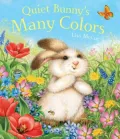
The brilliantly colorful follow-up to Lisa McCue's best-selling Quiet Bunny!Quiet Bunny loves the bright colors of spring: the yellow ducks, green frogs, and blue jays-everything but his own mousy brown fur. It takes the help of a wise old owl for Bunny to realize that it's the rainbow of colors--including his own--that makes the world so beautiful.
Synopsis
The brilliantly colorful follow-up to Lisa McCue's best-selling Quiet Bunny!
Quiet Bunny loves the bright colors of spring: the yellow ducks, green frogs, and blue jays-everything but his own brown, wintry white fur. It takes the help of a wise old owl for Bunny to realize that it's the rainbow of colors-including his own-that makes the world so beautiful.
Editorials
From Barnes & Noble
Nature's rainbow of colors displays its full radiance in this standalone sequel to Lisa McCue's Quiet Bunny! Another joyous bunny story just in time for Easter.
Publishers Weekly
In this follow-up to Quiet Bunny, the fluffy rabbit loves spring colors so much that he decides to brighten up his coat, with each wardrobe change ending in a small disaster. When he covers himself in honey and dandelions to become yellow, bees come a'buzzing. Wearing a floppy, green lily pad on his head causes him to stumble, and the blueberry juice he squeezes onto his fur washes off in a spring shower. As in the previous book, it's up to a wise owl to persuade Quiet Bunny to embrace his natural gifts. Moments of gentle humor keep McCue's hyperbucolic world from feeling cloying. Ages 4–6. (Mar.)From the Publisher
Praise for Lisa McCue's Quiet Bunny"The book is a natural read-aloud, allowing kids to join in the telling of the story" -School Library Journal
“The author's idyllic setting and canny sense of s tory-time dynamics should make this one a favorite.” - Publishers Weekly
School Library Journal
PreS-K—This treacly, message-driven picture book will likely please undemanding fans of cuteness but leave more-discerning readers disappointed. It is spring and Quiet Bunny decides that his brown-and-white fur is the color of winter. He wants to be the color of spring, so he turns yellow by covering himself with honey and then dandelions but falls into a stream that washes him clean. He then becomes green, blue, and red in turn, using lily pads, blueberries, and red mud. The mud hardens and he sadly washes it off in a stream, where the proverbially wise old owl (in a gatefold) tells him, "That is why the spring forest is beautiful….We are all different colors, and we are all beautiful!" The pedestrian text is overly long for the audience, and the didactic message lacks subtlety. The art, with a very fluffy bunny and bright, candy-colored flowers, has the look and feel of a greeting card. The pacing, with the use of spot art and full-bleed spreads, moves the story along nicely, although the gatefold is unnecessary and unlikely to hold up. On the whole, this is an unexceptional addition to the glut of books about colors.—Amy Lilien-Harper, The Ferguson Library, Stamford, CTKirkus Reviews
This is the second offering in a new series about the titular rabbit, following a previous exploration of animal sounds (Quiet Bunny, 2009). In this effort, Quiet Bunny finds out about the colors of the springtime and decides he doesn't want to be a plain brown-and-white rabbit any longer. He tries to turn himself yellow with honey and flower blossoms, green with lily pads, blue with blueberries and so on. A wise owl intervenes and points out that each animal has its individual color and that is what makes the forest beautiful. "We are all different colors, and we are all beautiful!" It's the old "be yourself" theme that has been told so many times and in so many ways, and this version really doesn't add anything new to the canon. The stereotypically wise owl solves the existential dilemma with a simple statement rather than allowing Quiet Bunny to come to the conclusion on his own, and the exploration is never anything more than superficial. McCue's illustrations combine undeniably cute and cuddly animals with lovely flowers, but it's all a greeting-card prettiness that comes off as saccharine. But since she is a prolific artist with many fans, Quiet Bunny will probably quietly move on to the next entry in his series. (Picture book. 3-5)Book Details
Published
March 1, 2011
Publisher
Sterling Publishing
Pages
32
Format
Hardcover
ISBN
9781402772092