
Jurisprudence, Civil Rights - United States, Courts & Trial Practice - General & Miscellaneous, Judicial System - General & Miscellaneous, Interpretation & Construction of Law
Available on Bookshop
Write a review
Books.org participates in affiliate programs including Bookshop.org and the Amazon Services LLC Associates Program. We may earn a commission from qualifying purchases made through links on this page, at no additional cost to you.
Log in to track your reading progress.
Overview
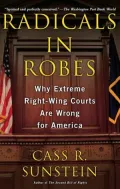
Praised as a must-have primer during the Roberts and Alito hearings, Radicals in Robes offers a rigorous yet accessible analysis of what’s at stake in the judiciary choices made during these warring days of the Warren/Rehnquist legacy. Radicals in Robes pulls away the veil of rhetoric from a dangerous and radical movement and issues a strong and passionate warning about what conservatives really intend.Editorials
Publishers Weekly
In this timely and keen analysis of how judges interpret the Constitution today, Sunstein, a University of Chicago law professor and New Republic contributor, espouses what he calls a "minimalist" approach that respects precedent and takes only small-scale steps forward, and lashes out at the "fundamentalism" practiced by extreme conservative judges. Legal fundamentalists profess to base their interpretations on the meanings ascribed to the Constitution by the original ratifiers. But in many respects, Sunstein says, fundamentalists ignore, or misread, the history they claim to venerate. Further, he says many fundamentalist positions would undermine liberties Americans have come to value--rights that one fundamentalist judge, offering the example of the right to privacy, says were created out of whole cloth by the Supreme Court. For Sunstein, capitulation to the fundamentalists could lead to state (but not federal) establishment of religion, to the elimination of a protected right to privacy and to invalidation of most environmental regulations. We should be skeptical, the author insists, when political ideology seems to dictate judges' constitutional doctrine. This compressed book covers all the hot-button constitutional issues in 10 short, plainly written chapters. Americans monitoring the upcoming Senate deliberations over Bush's nomination of John Roberts to the Supreme Court will want to bear in mind the arguments Sunstein so trenchantly presents. Agent, Sydelle Kramer. (Sept. 6) Copyright 2005 Reed Business Information.Kirkus Reviews
Attempting to support his alarmist view of how life would degrade under the sway of extreme right-wing judges, Sunstein (The Second Bill of Rights, 2004, etc.) nevertheless presents a surprisingly balanced history of constitutional law. Sunstein (Jurisprudence/Univ. of Chicago Law School) warns that legal fundamentalists, who interpret the Constitution according to the "original understanding," that is, how the framers and ratifiers conceived it, would deprive us of many of the freedoms and protections that we now take for granted. Fundamentalist courts would, for example, overturn Roe v. Wade on the basis that the Constitution does not protect privacy, strike as unconstitutional key provisions of anti-discrimination laws such as the Civil Rights Act and environmental safeguards such as the Clean Air Act, permit states to bar women from practicing as doctors or lawyers, declare even modest gun control laws invalid, scale back the rights of the accused, shield commercial advertising from government regulation and poke giant doorways in the wall that separates church and state. In fact, states could establish official religions. Sunstein's most compelling argument against fundamentalism is that the framers and ratifiers were only human, so the Constitution can't be perfect. Sunstein, however, does not establish a strong one-to-one correspondence between fundamentalism and extreme right-wing politics, other than to say that Justice Antonin Scalia, the most conservative member of the U.S. Supreme Court, is a fundamentalist. Not until near the end does he state, without much support, "The constitutional judgments of fundamentalists are eerily close to the political judgments of conservativepoliticians." His evidence that courts are generally shifting to the extreme right is also weak. Sunstein promotes a minimalist approach to constitutional law, which allows that it's okay to nudge the law carefully in one direction or another (right or left) with incremental decisions, rather than overreach, as he believes the Supreme Court did in Roe v. Wade. Not entirely the partisan screed that you'd expect, not especially provocative, but enlightening and in some places fascinating.Book Details
Published
April 28, 2009
Publisher
Basic Books
Pages
304
ISBN
9780786734894