
Teaching - Reading, Psycholinguistics & Language Acquisition, Developmental Psychology, Morphology
Available on Bookshop
Write a review
Books.org participates in affiliate programs including Bookshop.org and the Amazon Services LLC Associates Program. We may earn a commission from qualifying purchases made through links on this page, at no additional cost to you.
Log in to track your reading progress.
Overview
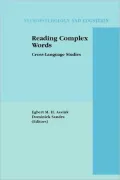
This book brings together current research findings on the involvement of word-internal structure for the purpose of word reading (especially morphological structure). The central theme of reading complex words is approached from several angles, such that the chapters span a wide variety of topics where this issue is important. It is a valuable resource for all researchers studying the mental lexicon and to those who teach advanced courses in the psychology of language.
Editorials
From The Critics
Reviewer: Jaumeiko JC Brown, Ph.D.(George Washington University)Description: This book addresses the impact of morphophonological awareness on lexical access and comprehension of complex words across languages. Semantics and verbal working memory are common threads in many of the chapters as factors that underlie efficient decoding, recoding, and encoding skills.
Purpose: The editors attempt to delineate the mechanisms by which mental representations of morphologically complex words are retrieved when reading by considering the following: differences in morphological and typological components in a variety of languages; children and adults who learn to read in a typical and atypical manner; and a variety of theoretical perspectives on morpheme-based lexical processing. Much research has focused on the role of phonological processes, specifically phonological representations, in lexical retrieval for articulation, reading, and writing. This book not only discusses the importance of morphology, but also indicates the combined effects of semantics, phonology, and syntax as well as other elements key in information processing such as verbal working memory in the aforementioned contexts.
Audience: The editors compiled empirical research regarding morphological awareness in reading to "stimulate discussion and communication amongst colleagues in this field." As such, many of the chapters are written in a technical format with an abbreviated, if any, explanation of key terms and the relationships between concepts. Therefore, this book is not geared towards practicing clinicians, but towards academicians and aspiring researchers. It is evident that the contributions are from studies with a robust methodology and cogent support for theories and findings.
Features: The book is a compilation of research regarding the role of morphological awareness and other pertinent processes cross-linguistically in the reading of complex words by children and adults with and without reading impairment. Since many of the contributing authors refer to terms, findings, and theories discussed in other chapters in the book, the index is quite helpful in locating those items to facilitate understanding of salient links amongst concepts.
Assessment: "As a researcher interested in the role of sublexical processes in reading acquisition, I found this book quite stimulating and informative. Although most chapters address morphological awareness, each of the contributing authors discusses a specific aspect of this construct in relation to other linguistic components such as orthographic and phonological relations, correlation between form and meaning, and real word versus pseudoword reading and production. Overall, the book is quite comprehensive and adds substantive information to the pool of data regarding sublexical processes and reading (e.g., Cowan, 1998; Gathercole, 1996; Gillam, 1998; Torgeson, Wagner, & Rashotte, 1994). REFERENCES Cowan, N. (1998). Short-term memory, working memory, and their importance in language processing. In R.B. Gillam (Ed.), Memory and Language Impairment in Children and Adults: New Perspectives (pp. 3-27). Gaithersburg, MD: Aspen Publishers. Gathercole, S.E. (1996). Models of Short-term Memory. Hove: Psychology Press. Gillam, R.B., A. (1998). Phonological awareness training and short-term working memory: Clinical implications. In R.B. Gillam (Ed.), Memory and Language Impairment in Children and Adults: New Perspectives (pp. 83-96). Gaithersburg, MD: Aspen Publishers. Torgesen, J.K., Wagner, R.K., & Rashotte, C.A. (1994). Longitudinal studies of phonological processing and reading. Journal of Learning Disabilities, 27, 276-286."
Book Details
Published
December 6, 2010
Publisher
Springer-Verlag New York, LLC
Pages
361
Format
Paperback
ISBN
9781441933973