
Short Story Collections (Single Author), Indian & South Asian Fiction
Log in to track your reading progress.
Overview
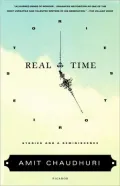
Amit Chaudhuri’s stories range across the astonishing face of the modern Indian subcontinent. From divorcées about to enter into an arranged marriage to the teenaged poet who develops a relationship with a lonely widower, from singing teachers to housewives to white-collar businessmen, Chaudhuri deftly explores the juxtaposition of the new and old worlds in his native India. Here are stories as sweet and ironic as they are deft and revealing.Editorials
New York Times Book Review
an immensely gifted writer who is less interested in one particular story than in all the bits and pieces of stories that make up ordinary life. This brilliantly nuanced first story collection, which ranges over thirty years of Indian life, is proof of his astonishing gifts.San Francisco Chronicle
Ironic portraits of young artist, old masters, middle managers—and gods—from one of the most dazzling new talents of any nationality.Publishers Weekly
Small slices of life in Bombay and Calcutta, intensely observed and exquisitely described, characterize the stories in Chaudhuri's first collection, after the highly praised novels Freedom Song and A New World. These vignettes, rendered in minute, sensuous detail, rarely relate a dramatic event; rather, they illuminate a moment in time. It's a measure of this talented writer's skill that on the small scale of 16 stories he is able to conjure, with sunstruck clarity, the different qualities of these cities and their inhabitants. Most of the tales are set between the 1970s and the present day (with the exception of two based on the Ramayana), and the characters are generally upper-middle-class. Some are minor administrators, others are employees of British industries; most appear content to adopt British language and customs. The incongruity of grafting Western standards on an ancient culture is central to many of these tales, and in the title story and elsewhere, Chaudhuri subtly mourns the fading of tradition. In other stories, and in two autobiographical selections, the protagonist is a would-be writer, and it's clear that many of Chaudhuri's themes come from his pampered upbringing in Bombay. In the affecting "The Old Masters," the narrator realizes that the financial and social success his ambitious father had achieved for the sake of his family will be "leveled out" by a son who vows to make a living through literature. "The romance of literature," the quality of being "enveloped in [the] contentment of reading," is summoned with both concrete detail and mystical yearning. One wishes, however, that some of the Indian terms and other references had been explained. For instance, David Davidar is mentioned but not identified, and it's unlikely that the average reader will know that he is India's most famous publisher. (Apr. 30) Copyright 2001 Cahners Business Information.Library Journal
The clash of cultures and lifestyles in modern India is palpable in this first book of stories by Calcutta novelist Chaudhuri (Freedom Song: Three Novels). In "The Man from Khurda District," Bishu, a cleaner, and his wife, Uma, are totally dependent upon the good will of their employer for all of life's necessities. Then they are fired and are forced to leave the housing provided for them: "Now that phase of their lives, which, after all, was so relatively brief that they had hardly become used to it, was ending, and another was about to begin." In stark contrast is the life we are shown in "White Lies," in which a successful CEO and his wife can have whatever they desire, including a guru. The everyday lives and diversities revealed here are beautifully described, but the use of many native words, unexplained and not evident by context, detract from the stories' effectiveness. The selections have no plot, their sole purpose evidently being to portray the many facets of Indian culture. These short, teasing vignettes left this reader wanting more. Patricia Gulian, South Portland, ME Copyright 2002 Cahners Business Information.Kirkus Reviews
A stylish if rather slight miscellany of 15 stories and a verse memoir, by the accomplished Indian author (A New World, 2000; Freedom Song, 1999). The stories are set mostly in Calcutta or Bombay and frequently turn on contrasts or conflicts generated by religious (Hindu-Muslim) or linguistic (Bengali-English) differences. For example, there are several seemingly autobiographical pieces, like "Portrait of an Artist," in which a 16-year-old poet learns poetic tradition from a melancholy English tutor; and "Four Days Before the Saturday Night Social," about a schoolboy's approach to "the echoing, fantastic-hued chambers of rock music." Little happens in Chaudhuri's otherwise exquisitely fashioned fiction: witness "The Great Game," a vignette that employs the phenomenon of soccer combat to underscore tensions between India and Pakistan; or an exceedingly thin few pages about a housewife's decision to write her inglorious "memoirs"; or even "An Infatuation" and "The Wedding," of tales from India's classical epic The Mahabharata. More substantial stories include "The Man from Khurda District," about a struggling domestic's ill-fated befriending of a phlegmatic bicycle thief; and especially "White Lies," a beautifully controlled piece about the addled relations among a "guru" who gives singing lessons to wealthy matrons, a "student" who hangs on his every note, and her increasingly impatient and frustrated husband. Elsewhere, mood and tone are more important than narrative, though evidence abounds of Chaudhuri's remarkable gift for verbal precision and nuance (e.g., old friends meeting after a 20-year separation find themselves "reminiscing about our childhood as if it were a book we'd bothrecently read"). The author's fluency is particularly well-displayed in the concluding "E-Minor," whose 25-plus pages of graceful free verse vividly evoke their narrator's Bombay childhood, conflicted family life and varied education, experiences in England and back home in India, and accession to marriage, fatherhood, and artistic maturity. One suspects that Chaudhuri emptied his filing cabinet to fill this slim volume. Nevertheless, he's a minor master, at the very least.Book Details
Published
April 1, 2003
Publisher
Picador USA
Pages
196
Format
Paperback
ISBN
9780312421144