
Network Programming, Video - Multimedia Technology, Computer Science & Combinatorics, Mathematics - Applied, Video Technology, Cryptography
Available on Bookshop
Write a review
Books.org participates in affiliate programs including Bookshop.org and the Amazon Services LLC Associates Program. We may earn a commission from qualifying purchases made through links on this page, at no additional cost to you.
Log in to track your reading progress.
Overview
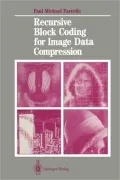
Recursive Block Coding, a new image data compression technique that has its roots in noncausal models for 1d and 2d signals, is the subject of this book. The underlying theory provides a multitude of compression algorithms that encompass two course coding, quad tree coding, hybrid coding and so on. Since the noncausal models provide a fundamentally different image representation, they lead to new approaches to many existing algorithms, including useful approaches for asymmetric, progressive, and adaptive coding techniques. On the theoretical front, the basic result shows that a random field (an ensemble of images) can be coded block by block such that the interblock redundancy can be completely removed while the individual blocks are transform coded. On the practical side, the artifact of tiling, a block boundary effect, present in conventional block by block transform coding techniques has been greatly suppressed. This book contains not only a theoretical discussion of the algorithms but also exhaustive simulation and suggested methodologies for ensemble design techniques. Each of the resulting algorithms has been applied to twelve images over a wide range of image data rates and the results are reported using subjective descriptions, photographs, mathematical MSE values, and h-plots, a recently proposed graphical representation showing a high level of agreement with image quality as judged subjectively.Book Details
Published
July 31, 2012
Publisher
Springer-Verlag New York, LLC
Pages
325
Format
Paperback
ISBN
9781461396789