
Racial Discrimination, Presidental Elections & Candidates, United States - Ethnic & Race Relations, U.S. Politics & Government - 1945 - 1989, Civil Rights - United States, U.S. Politics & Government - 1945 to Present, 20th Century American History - Polit
Log in to track your reading progress.
Overview
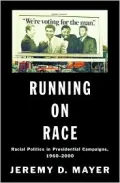
Racial politics has permeated American presidential campaigns for more than half a century. From John F. Kennedy to George W. Bush, presidents-to-be and their adversaries have dealt with the problems and the opportunities presented by America’s bitter racial divide. Some chose to embrace racial progress, others to play to the white backlash, and still others attempted to do both, often with surprising success.Jeremy D. Mayer has studied every presidential race from JFK’s campaign in 1960 to George W. Bush’s in 2000 and the crucial difference the black vote has made in each election.
Mayer discusses in detail:
• The 1960 election, where John F. Kennedy brilliantly straddled the civil rights issue. In an effort to satisfy white southerners, he spoke appeasing words to segregated white audiences, and to attract black voters, he called Coretta Scott King while her husband was imprisoned.
• The 1976 primary race between Ronald Reagan and Gerald Ford--the last time the black vote mattered for Republicans. Since then, the Republican path to the presidency has been almost entirely white, allowing Republicans to continue rightward on race without costs. Every Republican victory in the modern era has been a product of the incorrigibly white Republican coalition, a coalition nurtured even today by Bush’s ambivalence toward the Confederate flag in 2000.
• "The odd silence of Ronald Reagan,' who was known as a leading opponent of almost every civil rights bill and yet in his 1980 and 1984 campaigns largely avoided the topic. Mayer explains why Reagan’s strategy was so successful.
• the cynical exploitation ofthe fear of racial violence as a means to keep black voters loyal to the Democratic Party in the presidential elections of 1980, 1996, and 2000. Mayer shows how both parties have learned to play the race card with vicious effectiveness.
By looking at this all-important aspect of our political life and coming up with new information, Mayer offers fresh insights into one of the most significant factors in our process of determining who governs us.
Author Biography: Jeremy D. Mayer grew up in Arlington, Virginia, and received his undergraduate degree in political science from Brown University in 1990. After two years in Japan, he pursued graduate studies in politics at Oxford and Georgetown, receiving his Ph.D. from Georgetown in 1996. He is a visiting assistant professor of government at Georgetown. Mayer is also the author of the textbook 9-11: The Giant Awakens.
Editorials
Publishers Weekly
"Race and the array of issues surrounding it have been crucial to every presidential election since 1960," Mayer states, an obvious but routinely ignored fact that he documents campaign by campaign. The first campaign he focuses on offers a lucid, shocking reminder of Kennedy's pre-1960 courting of Southern segregationists, and Mayer her sets a standard that subsequent chapters fail to meet. He clearly delineates a pattern: except for 1964, "Democrats won only when they emulated Kennedy's calculated and symbolic outreach to racial conservatives," thus submerging the salience of race, provided Republicans let them. Yet, the ways this pattern played out including primaries and third-party runs and the ways issues changed over time, prevent this simple formula from producing cookie-cutter results. However, Mayer's accomplishment is marred by the increasing superficiality of his analysis as pre-1965 definitions of what constitutes racism become irrelevant, and no substantive discussion of emerging issues ensues. Thus, affirmative action as an issue recurs repeatedly, without any discussion of how it has actually functioned, both as a matter of law and fact. The same is true of busing it's a startling exception when Mayer notes that the 1984 Reagan campaign attack on busing in Charlotte, N.C., backfired because "the community was relatively proud of their record on busing by 1984." His reportage also declines his portrait of Jesse Jackson is as simplistic and distorted as his portrait of JFK is nuanced and complex. Mayer, a political scientist and visiting professor at Georgetown, offers a plausible yet disappointing exploration of an intriguing and accurate premise. Illus. not seen (On sale Aug. 20) Forecast: With its controversial subject matter, this will no doubt get reviews and sales, but readers savvy about race and politics will stick with Kenneth O'Reilly's more substantial Nixon's Piano: Presidents and Racial Politics from Washington to Clinton. (1995) Copyright 2002 Cahners Business Information.Library Journal
A Republican campaign policy of "malign neglect" toward African Americans helped elect Republican presidents in every election from 1968 through 1992, with the exception of Carter in 1976, says Mayer (political science, Georgetown Univ.). After Lyndon Johnson signed the Voting Rights Act in 1965, no Democrat won a majority of white votes. Mayer skillfully investigates the impact of race on presidential politics, without overemphasizing its importance compared with the economy and international relations. He is especially insightful in showing how Jesse Jackson hindered the hapless campaigns of Democrats Walter Mondale in 1984 and Michael Dukakis in 1988 and how Bill Clinton was elected to two terms with overwhelming African American support. As African Americans continue to gain more wealth, economic class, not race, will frame policies and issues, Mayer concludes. This excellent overview joins a number of recent investigations that discuss the connection between race and the presidency: DeWayne Wickham's Bill Clinton and Black America, Dean Kotlowski's Nixon's Civil Rights, and Michael Gardner's Harry Truman and Civil Rights. Mayer's is the only book in memory that discusses race and all presidential elections of the last 40 years. Highly recommended for academic and most public libraries. Karl Helicher, Upper Merion Twp. Lib., King of Prussia, PA Copyright 2002 Cahners Business Information.Kirkus Reviews
Comprehensive, thoughtful account of the role race played in recent American presidential elections. Since 1960, writes Mayer (Government/Georgetown Univ.), race has gained an importance in the national process of choosing a chief executive that it has not held since Reconstruction. The author does an exceptional job of plumbing the elections' content for racial themes and anecdotes. In the close race between Richard Nixon and JFK, for example, Nixon actually had the better record on civil rights; the black vote swung to Kennedy only in the last weeks of the campaign, following a phone call he made to Coretta Scott King after her husband was arrested on a trumped-up traffic charge in Georgia. In 1968, Nixon beat Hubert Humphrey, a liberal strongly associated with civil rights, by proclaiming himself "the law and order candidate," playing to white fears over recent race riots. Mayer discusses the rise to prominence of Jesse Jackson, who played a small role in Walter Mondale's failed bid against an ensconced Ronald Reagan, then returned in 1988 with a far broader coalition of labor, environmental, and other progressive groups to run an impressive primary campaign against Al Gore and Michael Dukakis. Ironically, the political season that brought Jackson's inspiring effort also brought the infamous Willie Horton TV ad, with George Bush and the GOP cynically playing the race card by linking Massachusetts Governor Dukakis to a black felon released on a state furlough program. Mayer also discusses some long-running issues that influenced presidential politics in this era (school busing, affirmative action, welfare reform) and chronicles Reagan's assault on civil-rights safeguards and socialprograms. As other races and ethnic groups come to figure prominently in the American political landscape during the 21st century, black/white issues will diminish as factors in presidential elections, Mayer concludes, but it will be some time before they cease to be important. Slightly arid, but a definitive survey, well written and thorough.Book Details
Published
August 20, 2002
Publisher
New York : Random House, c2002.
Pages
384
Format
Hardcover
ISBN
9780375506253