
Probability Theory, Physicists - Biography, Scientific Research, Mathematicians & Logicians - Biography, Descartes & 17th Century French Philosophy, Science, Philosophy of
Log in to track your reading progress.
Overview
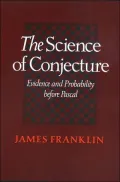
Before Pascal and Fermat's discovery of the mathematics of probability in 1654, how did we make reliable predictions? What methods in law, science, commerce, philosophy, and logic helped us to get at the truth in cases where certainty was not attainable? In The Science of Conjecture, James Franklin examines how judges, witch inquisitors, and juries evaluated evidence; scientists weighed reasons for and against scientific theories; and merchants counted shipwrecks to determine insurance rates. Sometimes this type of reasoning avoided numbers entirely, as in the legal standard of "proof beyond a reasonable doubt"; at other times it involved rough numerical estimates, as in gambling odds or the level of risk in chance events.
The Science of Conjecture provides a history of rational methods of dealing with uncertainty. Everyone can take a rough account of risk, Franklin argues, but understanding the principles of probability and using them to improve performance is an immense task—a task that had to be learned over human history, just as we had to train ourselves to become aware of the principles of perspective. The theme of this study is the coming to consciousness of human understanding of risk.
A well-reasoned and highly readable study, The Science of Conjecture makes an important contribution to intellectual history and the history of science.
Book Details
Published
July 23, 2002
Publisher
The Johns Hopkins University Press
Pages
512
Format
Paperback
ISBN
9780801871092