
Literary Collections
Log in to track your reading progress.
Synopsis
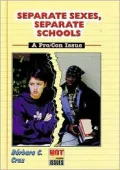
Examines the pros and cons of single-sex education, its risks, benefits, and results, specifically discussing both girls-only and boys-only schoolsEditorials
VOYA
Although written by different authors, books in the Hot Pro/Con Issue series follow essentially the same format. The issue is defined, historical background is given, and arguments supporting an issue are followed by those opposing it before ideas are presented for changes that might reconcile the two camps. The brief length prohibits in-depth analyses, but pros and cons are argued persuasively, passionately, and often in politically correct voices. The topics are current and in demand by teens. Chapter titles and sections are in bold red print, making it easy to flip through to find information. To illustrate both sides of the issue of separate-sex schools, Cruz presents several scenarios. It appears that more is learned when the sexes are separated, but the main argument for keeping teens together is to provide social interaction. Interestingly, one statistic points out that there are almost eighty female-only colleges but only three male-only colleges left in America. Other titles in the series are Abortion Conflict, Animal Experimentation and Testing, Drug Legalization, Drug Testing in Schools, Rain Forests, and Space Exploration. Recommend the books in this series for debate preparation and reports, although they should not be the only sources students use. If budgets allow, purchase one copy for circulating and one for reference. Index. Illus. Photos. Maps. Charts. Source Notes. Further Reading. VOYA CODES: 3Q 4P M J S (Readable without serious defects; Broad general YA appeal; Middle School, defined as grades 6 to 8; Junior High, defined as grades 7 to 9; Senior High, defined as grades 10 to 12). 2000, Enslow, 64p. PLB . Ages 12 to 18. Reviewer: Pam Carlson SOURCE:VOYA, June 2001 (Vol. 24, No. 2)School Library Journal
Gr 6-10-This brief overview of single-sex education introduces readers to the history of coeducation in the United States and presents arguments for and against girls-only and boys-only schools. The first two sections are devoted to background information on the controversy and past practices. Both successful and unsuccessful case studies of school systems around the country are cited. Noted experts like Michael Ruhlman, author of Boys Themselves (Holt, 1997), and representatives from the American Association of University Women weigh in with their opinions. Surveys and statistics stand out in bulleted text boxes and sources are cited in an extended bibliography. The following four sections make a case for and against sex-specific schools. Though the narrative isn't particularly passionate or lively, the facts are presented in a balanced fashion that contains enough information for students who are doing research or are interested in attending a single-sex school.-Katie O'Dell, Multnomah County Library, Portland, OR Copyright 2000 Cahners Business Information.Book Details
Published
August 1, 2000
Publisher
Enslow Publishers
Pages
64
Format
Binding
ISBN
9780766013667