
Racial Discrimination, South Africa - History, Africa - Social Conditions, South African Politics & Government, General & Miscellaneous African History
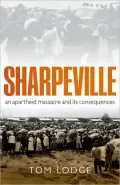
Available on Bookshop
Write a review
Books.org participates in affiliate programs including Bookshop.org and the Amazon Services LLC Associates Program. We may earn a commission from qualifying purchases made through links on this page, at no additional cost to you.
Log in to track your reading progress.
Overview
On March 21, 1960, a line of 150 white policemen fired 1344 rounds into a crowd of several thousand people assembled outside a police station, protesting against the Apartheid regime's racist "pass" laws. The gunfire left in its wake sixty-seven dead and one hundred and eighty six wounded. Most of the people who were killed were shot in the back, hit while running away.
The Sharpeville Massacre, as the event has become known, marked the start of armed resistance in South Africa, and prompted worldwide condemnation of South Africa's Apartheid policies. In Sharpeville, Tom Lodge explains how and why the Massacre occurred, looking at the social and political background to the events of March 1960 as well as the long-term consequences of the shootings. Lodge offers a gripping account of the Massacre itself as well as the wider events that accompanied the tragedy, particularly the simultaneous protest in Cape Town which helped prolong the political crisis that developed in the wake of the shootings. Just as important, he sheds light on the long term consequences of these events. He explores how the Sharpeville events affected the perceptions of black and white political leadership in South Africa as well as South Africa's relationship with the rest of the world, and he describes the development of an international "Anti-Apartheid" movement in the wake of the shootings.
In South Africa today, March 21 is a public holiday, Human Rights Day, and for many people, it remains a day of mourning and memorial. This book illuminates this pivotal event in South African history.
Editorials
Publishers Weekly
Lodge's study of the Sharpeville massacre is a meticulous but overstuffed history of the 1960 clash between black protestors and white policemen in the South African township of Sharpeville, which left 67 protestors dead and nearly 200 wounded, most shot in the back while running away. Lodge (Mandela) offers a detailed account of the causes and consequences of the massacre, credited for drawing global condemnation of apartheid, but his book also presents an expansive history of the South African liberation movement. Drawing on the papers of Robert Sobukwe, the first president of the Pan Africanist Congress, whose nonviolent protest preceded the Sharpeville massacre, Lodge creates a nuanced portrait of the less well-known revolutionary group within the context of more familiar players like the African National Congress, the international antiapartheid movement, and the South African state. The book is especially compelling when it focuses on the local history and politics of Sharpeville, and overall, Lodge's research strikes an impressive balance between documenting the historical facts of the clash and tracing the narratives and political momentum that ramified in its wake. (July)From the Publisher
"Lodge's brilliantly complex yet eminently readably analysis tops a list of works of more narrow scope to offer a comprehensive view...A must read for libraries, scholars, and general readers interested in the place, period, or process of racialist South Africa's unraveling." -- Library Journal (Starred review)
Library Journal
White South Africa's apartheid police shot dead 67 blacks and wounded 186 more at a protest on March 21, 1960, in Sharpeville, a township outside Johannesburg. The wanton slaughter rallied black South Africa's liberation movement. It also rang an international antiapartheid alarm, explains Lodge (peace & conflict studies, Univ. of Limerick; Mandela: A Critical Life). He investigates what was truly singular about the massacre in its national and international settings. He shows Sharpeville as no moment of revolutionary transformation, liberalization, modernization, or social disintegration. Rather, he argues, Sharpeville shone a glaring and timely spotlight on the fragility of apartheid's power inside South Africa, and it focused international indignation in Europe and North America that increased empathy with black South Africans. VERDICT Lodge's brilliantly complex yet eminently readable analysis tops a list of works of more narrow scope to offer a comprehensive view with half-a-century's perspective on the long-developing collapse of apartheid South Africa. This work is a must for libraries, scholars, and general readers interested in the place, period, or process of racialist South Africa's unraveling.—Thomas J. Davis, Arizona State Univ., TempeBook Details
Published
June 10, 2011
Publisher
Oxford University Press, USA
Pages
256
Format
Hardcover
ISBN
9780192801852