
World Literature, Fiction Subjects, Peoples & Cultures - Fiction
Available on Bookshop
Write a review
Books.org participates in affiliate programs including Bookshop.org and the Amazon Services LLC Associates Program. We may earn a commission from qualifying purchases made through links on this page, at no additional cost to you.
Log in to track your reading progress.
Overview
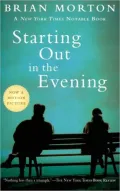
Leonard Schiller is a novelist in his seventies, a second-string but respectable talent who produced only a small handful of books. Heather Wolfe is an attractive graduate student in her twenties. She read Schiller’s novels when she was growing up and they changed her life. When the ambitious Heather decides to write her master’s thesis about Schiller’s work and sets out to meet him—convinced she can bring Schiller back into the literary world’s spotlight—the unexpected consequences of their meeting alter everything in Schiller’s ordered life. What follows is a quasi-romantic friendship and intellectual engagement that investigates the meaning of art, fame, and personal connection. "Nothing less than a triumph" (The New York Times Book Review), Starting Out in the Evening is Brian Morton’s most widely acclaimed novel to date.Awarded the 1999 Koret Jewish Book Award for Fiction.
Editorials
Publishers Weekly -
Morton, a magazine editor whose only previous novel was The Dylanist, is a deceptively simple writer. The beginning of his new book is so apparently artless it gives no hint of the subtle, tender and moving story to come. Leonard Schiller is an elderly novelist, one of the few surviving members of the Upper West Side Jewish intellegentsia of the 1940s and '50s. He has written two books that achieved some good critical attention, two more that disappeared virtually without a trace, but he still labors on--obese, slow and subject to heart murmurs, but trying doggedly to complete a last work before his life gives out. It is a life that has been devoted so singlemindedly to his work, as a sort of cultural duty, that he is unprepared for a dizzy rush of emotion when graduate student Heather Wolfe erupts vividly into his restricted orbit. A worshipful acolyte, she wants to write her thesis on him, perhaps restore him to a place in the literary pantheon. Leonard's daughter Ariel, sweet-naturedly muddling her way through life, a perpetual loser in love, has her own agenda: a baby before it is too late--but with whom? The three interrelate, eventually with Ariel's old flame Casey, too, in many surprising and often touching ways. Their stories are illuminated always with the gentle grace of Morton's writing--for as the narrative builds, it turns out to be far from artless. Only a rather too easy feel-good ending, which leaves an important question unresolved, slightly mars what is otherwise an elegiac tale at once strong-minded and profoundly compassionate. (Jan.) (PW best book of 1998)Library Journal
In beautifully nuanced scenes, Heather Wolfe, a 24-year-old graduate student, forces a meeting with broken-down Leonard Schiller, an out-of-print, sick old writer whose early works, written during the heyday of 1940s and 1950s New York intellectualism, forever changed Heather's life. Targeted as the subject of Heather's master's thesis, Schiller quickly falls under the seductive promise of her admiration, much to the distress of Ariel, his 39-year-old daughter, whose own struggles with failed romance and childlessness derail her energy. Morton (The Dylanist, HarperCollins, 1991) demonstrates an astonishingly sensitive appreciation for his characters as he reveals with unnerving accuracy the most private thoughts not only of his women but of the dying old man as well. These mismatched souls gradually realize that their individual journeys, which they thought were drawing to a close, are in fact new beginnings. Morton's respect for his characters and his audience is a quiet literary triumph. Highly recommended. [Previewed in Prepub Alert, LJ 9/1/97.]Beth E. Andersen, Ann Arbor Dist. Lib., Mich.Book Details
Published
October 1, 2007
Publisher
Houghton Mifflin Harcourt
Pages
336
Format
Paperback
ISBN
9780547451596