
20th Century American Literature - Pre WWII - Literary Criticism, Critics & Historians - Literary Biography, U.S. Poets - Literary Biography
Available on Bookshop
Write a review
Books.org participates in affiliate programs including Bookshop.org and the Amazon Services LLC Associates Program. We may earn a commission from qualifying purchases made through links on this page, at no additional cost to you.
Log in to track your reading progress.
Overview
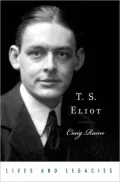
The winner of the Nobel Prize for Literature, the twentieth century's most famous poet and its most influential literary arbiter, T.S. Eliot has long been thought to be an obscure and difficult poet--forbiddingly learned, maddeningly enigmatic.
Now, in this brilliant exploration of T.S. Eliot's work, prize-winning poet Craig Raine reveals that, on the contrary, Eliot's poetry (and drama and criticism) can be seen as a unified and coherent body of work. Indeed, despite its manifest originality, its radical experimentation, and its dazzling formal variety, his verse yields meaning just as surely as other more conventional poetry. Raine argues that an implicit controlling theme--the buried life, or the failure of feeling--unfolds in surprisingly varied ways throughout Eliot's work. But alongside Eliot's desire "to live with all intensity" was also a distrust of "violent emotion for its own sake." Raine illuminates this paradoxical Eliot--an exacting anti-romantic realist, skeptical of the emotions, yet incessantly troubled by the fear of emotional failure--through close readings of such poems as "The Love Song of J Alfred Prufrock," "Gerontion," The Hollow Men, Ash Wednesday, and many others. The heart of the book contains extended analyses of Eliot's two master works--The Waste Land and Four Quartets. Raine also examines Eliot's criticism--including his coinage of such key literary terms as the objective correlative, dissociation of sensibility, the auditory imagination--and he concludes with a convincing refutation of charges that Eliot was an anti-Semite.
Here then is a volume absolutely indispensable for all admirers of T.S. Eliot and, in fact, for everyone who loves modern literature.
Synopsis
The twentieth century's most famous poet and its most influential literary arbiter, T.S. Eliot has long been thought to be an obscure and difficult writer-forbiddingly learned, maddeningly enigmatic. In this compelling exploration, prize-winning poet Craig Raine finds a way to read and make sense of Eliot's full corpus. He illuminates a paradoxical Eliot—an exacting anti-romantic realist, skeptical of the emotions, yet incessantly troubled by the fear of emotional failure—through close readings of his poetry, with extended analyses of Eliot's two master works—The Waste Land and Four Quartets. Raine also examines Eliot's criticism—including his coinage of such key literary terms as the objective correlative, dissociation of sensibility, the auditory imagination, and his biography, crafting a book that provides a concise introduction for beginners and a provocative set of arguments for Eliot admirers.Editorials
Michiko Kakutani
Unlike many academic critics who have expended huge amounts of energy on uncovering Eliot’s sources, pointing to obscure allusions that might unlock hidden meanings in the verse, Mr. Raine zeros in on the emotional core of the poems, using his own familiarity with Eliot’s work to give the lay reader a visceral understanding of how the poet came to articulate his ideas and how those ideas evolved over the years.As a poet himself, Mr. Raine has a practitioner’s understanding of language and rhythm and sound, and he uses this knowledge to convey the beauty and power of Eliot’s verse, and the myriad, subtle ways it works its magic on the reader.
— The New York Times
Book Details
Published
September 1, 2011
Publisher
Oxford University Press
Pages
224
Format
Paperback
ISBN
9780199774173