
Biography - General & Miscellaneous, Political Culture, Participation & Pluralism in Democracies, U.S. Politics & Government - 20th Century, United States Studies - General & Miscellaneous, Political Sociology, U.S. Politics & Government - 1992-2001, Mass
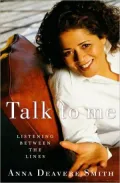
Available on Bookshop
Write a review
Books.org participates in affiliate programs including Bookshop.org and the Amazon Services LLC Associates Program. We may earn a commission from qualifying purchases made through links on this page, at no additional cost to you.
Log in to track your reading progress.
Overview
Anna Deavere Smith, the award-winning playwright and actor, has spent a lifetime listening—really listening—to the people around her. As a child in the segregated Baltimore of the early 1960s, Smith absorbed the words of her parents, teachers, neighbors—even train conductors—and realized that there was something more being communicated than the actual words:The conductor's voice had a mild kind of grandeur that was a cousin to the vocal tones I had heard at funerals—"Ashes-to-ashes"—and at christenings and weddings. These are words that have been said many times, but the person who speaks them understands that each time it must be said as if it matters, because it does matter. We never know what lies ahead, and we never know what just happened, and all words must house respect of those two unknowns.
In Talk to Me, Smith looks back at a singular career as a seeker and interpreter of language in America, revealing the methodology behind her extraordinary search for the truth and nuances of verbal communication. For thirty years, the defining thesis of Smith's work has been that how we speak is just as important in communicating truth and identity as what we say. Everything from individual vocal tone to grammar, Smith demonstrates, can be as identifiable and revealing as a fingerprint. Her journey has taken her from the rarefied bastions of academia to riot-torn streets; she has conducted hundreds of interviews with subjects ranging from women prisoners to presidents of the United States. In 1995, her ongoing investigation led her to Washington, D.C. After all, what better place to wage an inquiry into the power of language and the language of power than in the city where "message" is a manufactured product? What happens when we as citizens accept—which we seem to be doing more and more—our chosen leaders' failure to tell the truth? And how can we know that we are hearing what Washington really has to say when everything we receive is filtered through the media?
Armed with a blazing intellect and a tape recorder, Smith tackled these questions head-on, conducting more than four hundred interviews with people both inside and outside the power structure of Washington. She recorded these sessions in her trademark verbatim transcripts, which include every tic and verbal utterance of her subjects. More than thirty of these remarkable documents appear in this book, including interviews with Bill Clinton, Anita Hill, Studs Terkel, George Bush, Mike McCurry, and Helen Thomas. After five years of searing investigation into the world of the politicians, spin doctors, and power brokers who are steering the course of our country from inside the beltway, Smith has come away with a revelatory assessment—by turns devastating and hopeful—of the lexicon of power and politics in America. Talk to Me is a landmark contribution from a woman whose pioneering insights into language speak volumes.
Synopsis
Anna Deavere Smith, the award-winning playwright and actor, has spent a lifetime listening—really listening—to the people around her. As a child in the segregated Baltimore of the early 1960s, Smith absorbed the words of her parents, teachers, neighbors—even train conductors—and realized that there was something more being communicated than the actual words: The conductor's voice had a mild kind of grandeur that was a cousin to the vocal tones I had heard at funerals—"Ashes-to-ashes"—and at christenings and weddings. These are words that have been said many times, but the person who speaks them understands that each time it must be said as if it matters, because it does matter. We never know what lies ahead, and we never know what just happened, and all words must house respect of those two unknowns. In Talk to Me, Smith looks back at a singular career as a seeker and interpreter of language in America, revealing the methodology behind her extraordinary search for the truth and nuances of verbal communication. For thirty years, the defining thesis of Smith's work has been that how we speak is just as important in communicating truth and identity as what we say. Everything from individual vocal tone to grammar, Smith demonstrates, can be as identifiable and revealing as a fingerprint. Her journey has taken her from the rarefied bastions of academia to riot-torn streets; she has conducted hundreds of interviews with subjects ranging from women prisoners to presidents of the United States. In 1995, her ongoing investigation led her to Washington, D.C. After all, what better place to wage an inquiry into the power of language and the language of power than in the city where "message" is a manufactured product? What happens when we as citizens accept—which we seem to be doing more and more—our chosen leaders' failure to tell the truth? And how can we know that we are hearing what Washington really has to say when everything we receive is filtered through the media? Armed with a blazing intellect and a tape recorder, Smith tackled these questions head-on, conducting more than four hundred interviews with people both inside and outside the power structure of Washington. She recorded these sessions in her trademark verbatim transcripts, which include every tic and verbal utterance of her subjects. More than thirty of these remarkable documents appear in this book, including interviews with Bill Clinton, Anita Hill, Studs Terkel, George Bush, Mike McCurry, and Helen Thomas. After five years of searing investigation into the world of the politicians, spin doctors, and power brokers who are steering the course of our country from inside the beltway, Smith has come away with a revelatory assessment—by turns devastating and hopeful—of the lexicon of power and politics in America. Talk to Me is a landmark contribution from a woman whose pioneering insights into language speak volumes.Editorials
Publishers Weekly -
Catapulted to national prominence for her virtuosic one-woman show, Twilight, Los Angeles: 1992, actress and playwright Smith struck a nerve impersonating (based on her own interviews) scores of participants and bystanders in the 1992 riot following the acquittal of the police officers accused of beating Rodney King. Here, she weighs in with fertile ruminations on her philosophy of acting, observations on the daily political theater in Washington, D.C., and outtakes from the interviews she conducted for House Arrest, the most recent installment in her ongoing series of plays "in search of the American character." Soon after she decided in 1995 to take the presidency as her next subject, she realized, "I knew nothing about the president... that the press didn't tell me." To get the whole story, Smith interviewed President Clinton and former presidents Bush and Carter, as well as high-ranking political insiders (including former press secretary Mike McCurry and labor secretary Alexis Herman), members of the press (Peggy Noonan, Ben Bradley) and assorted cultural commentators (filmmaker Ken Burns, scholar Judith Butler). The resulting performances in Los Angeles and New York faced mixed reviews; while provocative, the play was criticized for lacking the dramatic coherence of her previous work (it is currently in hiatus). Composed of a series of brief vignettes punctuated with edgy verbatim monologues by various Washington insiders, the book shows signs of similar organizing struggles. Though prone to tangents, Smith is at her most incisive when probing the abiding parallels between the theater and politics. Her fans will appreciate this behind-the-scenes view of her signature technique and her unique perspective on the intersection of art and politics. Agent, Gloria Loomis. (Oct.) Copyright 2000 Cahners Business Information.Library Journal
Smith, an unusual combination of actor and journalist, puts together monologs taken directly from her interviews and performs them. Her project, "On the Road: A Search for American Character," has been running since 1980. Here is an account of her recent excursion to Washington. Copyright 2000 Cahners Business Information.\Barbara Tannenbaum
Anna Deveare Smith has demonstrated an uncanny ability to delve into the humanity of even the most guarded politician...vulnerable admissions pepper Smith's book and go long way in aiding her quest to uncover the human face of power and politics.—Biography
Kirkus Reviews
A playwright serves up her memoirs—heavily laced with politics. Smith (Fires in the Mirror, 1993) weaves together the story of her own dramatic training with observations about Washington during the 1990s. Smith's idée fixe is truth, and she looks for truth in the theater as well as in the corridors of power in Washington. Some, she says, may think that acting is about telling fibs—but real acting, good acting, is about telling profound truths. Success in Washington, however, may be about just the opposite. Smith claims that she taught a group of college kids about the iambs and trochees of poetic scansion by playing a video of Barbara Jordan's speech denouncing the Constitution's failure to recognize and protect her civil rights: Jordan, a famously stilted orator who often spoke in iambic pentameter, declared trochaically that the Constitution ought to be relegated to a"twentieth-century paper shredder." That trochee (and it is no coincidence that Shakespeare used trochees to signify madness or collapse) was what her students remembered from the speech. Smith makes clear her interest in public life: she writes about the O.J. Simpson verdict and describes how she kept turning a dinner date on its head to keep watching the Clarence Thomas hearings. There are also some considerations of black church-burnings in the South, Monica's blue dress, and the Rodney King riots. On the subject of history (describing her fascination with all things Jeffersonian), she registers her shock at reading the blatantly racist passages in Jefferson's Notes on the State of Virginia. Although Smith's ear is well-tuned for the stage, it must be admittedthather penchant for lapsing into poetry or monologue makes for disjointed reading. One only wishes she could perform this.Book Details
Published
January 1, 2001
Publisher
Random House
Pages
320
ISBN
9780375506406