
Outdoor & Recreational Areas, Teaching - Art, Geography & Mapping, Teaching - General & Miscellaneous, Parenting & Family Activities, Child Rearing & Development, Fiction - General & Miscellaneous, World History - General & Miscellaneous, Ethnology, Home
Log in to track your reading progress.
Overview
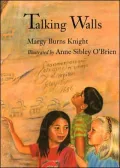
Talking Walls introduces young readers to different cultures by exploring the stories of walls around the world and how they can separate or hold communities together. American Bookseller "Pick of the Lists; " Boston GLobe Top 25 Non-Fiction Children's Books, 1992; ALA Booklist, Starred Review; Horn Book, Noteworthy Book, 1993. Full-color illustrations.An illustrated description of walls around the world and their significance, from the Great Wall of China to the Berlin Wall.
Synopsis
Talking Walls introduces young readers to different cultures by exploring the stories of walls around the world and how they can separate or hold communities together. American Bookseller "Pick of the Lists; " Boston GLobe Top 25 Non-Fiction Children's Books, 1992; ALA Booklist, Starred Review; Horn Book, Noteworthy Book, 1993. Full-color illustrations.
Publishers Weekly
Knight and O'Brien explore notable walls the world over as both symbols and vehicles for cultural connection; PW called this book ``a praiseworthy celebration of similarities and differences among the world's peoples.'' Ages 5-13. (Aug.)
Editorials
Publishers Weekly -
Knight and O'Brien explore notable walls the world over as both symbols and vehicles for cultural connection; PW called this book ``a praiseworthy celebration of similarities and differences among the world's peoples.'' Ages 5-13. (Aug.)Children's Literature -
For teachers, there is this additional guide for Talking Walls. It provides a wealth of ideas in geography, math, social studies, art, cooking, research projects, etc. for all grades through junior high. This is a wonderfully rich and challenging combination of book and guide when paired with Talking Walls.School Library Journal
Gr 3-6-- A unique introduction to the history and beliefs of a diverse group of cultures. In each of the 14 double-page spreads, Knight journeys to a new location, presenting information and folklore about famous walls all over the world. Some of the choices are obvious: the Great Wall of China, the Lascaux Cave, the Vietnam Veterans Memorial, the Berlin Wall. Others are less traditional but imaginatively appropriate: the Mexican murals of Diego Rivera, the Canadian Museum of Civilization, Nelson Mandela's prison walls. Although each vignette is brief, the author holds readers' interest with personalized stories, such as the one of a young boy who proudly chalks his handprint next to those of his ancestors on an Aborigine cave wall, or the Jewish child who solemnly places his handwritten Hebrew prayer in a crevice of the Western Wall in Jerusalem. Additional information is provided at the back of the book, as are two simple maps and endpapers that feature the word for wall in 36 languages. Beautifully executed pastel paintings capture the variety and vitality of each culture presented. Use this to launch a discussion about the uses and abuses of boundaries, or connect it to more familiar sights such as graffiti or billboards, and talk about walls as a means of cultural expression. --Joy Fleishhacker, New York Public LibrarySchool Library Journal
Gr 3-7-This recording of the two title books by Margy Burns Knight (Tilbury House) presents each story as a short vignette with musical accompaniment separating them. The many problems of this recording begin with the musical accompaniment. The sound quality is very uneven, ranging from a clanging gong that will jar listeners to an indistinguishable humming that causes the speakers to buzz. One of the Native American chants borrowed from another recording is well done, accenting the story authentically, but the calypso-style music, which begins the Mexican story, is not compatible with the location. The stories constitute a multicultural collection ranging from the famous--the Great Wall of China and the Wailing Wall--to the lesser-known walls of Zimbabwe and Chilean Pablo Neruda's home. These stories, while interesting and informative, are occasionally more political commentary than juvenile entertainment. The comparison between Angel Island, California and Ellis Island skews facts, giving the impression that European immigrants coming through New York easily entered the U.S. as opposed to the Chinese immigrants processed through California. Perhaps the biggest deficit of the recording is the reading itself. The slow, deliberate pace is flat and tedious, lacking in expression. Unnatural phrasing makes the stories hard to follow at times. The accent of the author/reader interferes with the pronunciation of several ethnic words and names (i.e. Ravana, Orozco, apartheid), negating the multicultural value of the tales.-Diana Baker Freeman, Hardin-Simmons University, Abilene, TXBook Details
Published
January 1, 1992
Publisher
Tilbury House Publishers
Pages
40
Format
Paperback
ISBN
9780884481546