
World Politics, International Relations - General & Miscellaneous, Nationalism & Sovereignty - General & Miscellaneous, General & Miscellaneous - Politics & Government
Available on Bookshop
Write a review
Books.org participates in affiliate programs including Bookshop.org and the Amazon Services LLC Associates Program. We may earn a commission from qualifying purchases made through links on this page, at no additional cost to you.
Log in to track your reading progress.
Overview
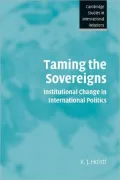
Kalevi Holsti inquires as to how we identify "change" in international politics and distinguish between significant and unimportant changes. Do we really live in a new era or simply see more continuity than transformation in international politics? Combining theoretical and empirical arguments, Holsti investigates eight major international institutions, including sovereignty, international law and territoriality, and speculates on their consequences.
Editorials
Foreign Affairs
It is a cliche to say that the attacks of September 11 fundamentally changed international politics. But breathless announcements of "new eras," "epochal shifts," and "historic moments" occur all the time. In Taming the Sovereigns, Canadian scholar Holsti steps back from the rush of current events to consider more broadly how scholars think about and chart international change. His careful judgments, if not entirely surprising, are a useful counterpoint to the glib rhetoric of transformation. He identifies several basic types of change: quantitative shifts, such as growth in population or trade flows; increased complexity, such as in the rules and institutions of diplomacy; and the transformation of political actors themselves. Using this framework, he surveys long-term change in various aspects of world politics, including the state system, territoriality, sovereignty, international law, diplomacy, trade, and war. From his baseline conception of a "society of states" in which relations are regulated by Westphalian norms and institutions, he finds continuity and creeping complexity more than a sharp transformation toward a de-territorialized, borderless world. Others, however, might see the rise of U.S. unipolarity and the seeming end of great-power war as part of a more profound change.Book Details
Published
January 22, 2004
Publisher
New York : Cambridge University Press, 2004.
Pages
372
Format
Paperback
ISBN
9780521541923