
U.S. Politics & Government - 1945 - 1989, Political Sociology, The United States Senate, 20th Century American History - Cold War, U.S. Politics & Government - 1952-1961, Legislators - U.S. Political Biography, Presidental Elections & Candidates, Terroris
Log in to track your reading progress.
Overview
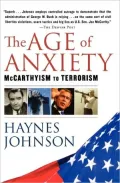
For five long years in the 1950s, Senator Joseph McCarthy’s anti-Communist crusade dominated the American scene, terrified politicians, and destroyed the lives of thousands of U.S. citizens.
In The Age of Anxiety, now updated with a new afterword, Johnson tells this monumental story through the lens of its relevance to our own time, when the current administration has created a culture of fear that again affects American behavior and attitudes. He believes now, as then, that our civil liberties, our Constitution, and our nation are at stake as we confront the ever more difficult task of balancing the need for national security with that of personal liberty.
Editorials
From Barnes & Noble
For five years in the early '50s, America was held hostage by the fear of extremism. Senator Joseph McCarthy and his anti-Communist crusade dominated the national scene. Even politicians who loathed the Wisconsin populist would not attack him; other office seekers rode his coattails to victory. Not even President Dwight Eisenhower felt that he could speak publicly about the menace of the senator's Washington witch hunt. In Age of Anxiety, Haynes Johnson revisits a time when a perceived external menace threatened to undermine American institutions.Publishers Weekly
Sen. Joseph McCarthy's Communist witch hunt was one of the darkest chapters in our nation's history, and Pulitzer Prize-winning journalist Johnson brings that story-along with some disturbing comparisons to our current political climate-startlingly to life. Conservatives may take umbrage with Johnson's criticism of President Bush's regime and the comparisons to McCarthyism, but no matter one's political affiliation, one cannot help being ashamed and horrified that such sinister machinations have happened-and may be happening again-in our nation. Approximately three-fourths of the book is devoted to a historical recounting of McCarthy's crusade, with the remaining quarter spent comparing McCarthyism to present-day politics. This production is so expertly abridged, listeners get the complete picture without feeling like anything has been left out. Narrator Tabori, in his deep, resonant and impassioned voice, authoritatively relates this brilliant piece of journalism in a style reminiscent of the voiceovers used in historical documentaries or by wartime news anchors. Tabori's diction is precise and compelling, and adds a memorably emotional impact to this already powerful work. Simultaneous release with the Harcourt hardcover (Reviews, July 25). (Oct.) Copyright 2005 Reed Business Information.Library Journal
Pulitzer Prize-winning journalist Johnson (The Best of Times) scrutinizes and compares the McCarthy era of the 1950s with our own time, ultimately noting that the government's restrictive reactions to 9/11 indicate that "McCarthyism remains a story without an end." Most of Johnson's book looks at the rise and fall of Sen. Joseph McCarthy, who transformed himself from a little-known senator from Wisconsin to the volatile politician who dominated the American political scene in the early 1950s by building on the American public's fear of communism. Johnson notes that President Eisenhower hated McCarthy but refused to confront him, and he covers the other familiar personalities in the story, including Edward R. Murrow, whose radio broadcast triggered the senator's downfall, and Joseph Welch, the honorable attorney who finally ended McCarthy's seemingly unopposed anticommunism crusade. Assessing the subsequent years, Johnson makes a strong case that in responding to national threats toward our country, the covert actions and reactionary behaviors of those in government have changed very little from McCarthy's time. In the world today, he points out, we have learned that the Age of Anxiety does not belong to just one generation and that the government continues to play on people's fears, divide the country, and limit civil rights in the name of fighting an enemy. Recommended for all public libraries.-Nancy Larrabee, Greenburgh P.L., Elmsford, NY Copyright 2005 Reed Business Information.Kirkus Reviews
Give a demagogue a pliant press and colleagues fearful of losing power if they protest his excesses, and you have McCarthyism-or perhaps the current Congress. It only seems, writes Johnson (The Best of Times, 2001, etc.), that America "entered an unprecedented era of stress and danger-an Age of Anxiety unlike anything experienced before" after the 9/11 attacks. But the early Cold War years were more dislocating: Fear was everywhere in the air, and all a power-hungry politico like Joseph McCarthy, literally schooled in Mein Kampf, had to do was find the right nerve to probe. He found it in the widespread fear that Commies lurked under every bed and in every closet, and for a couple of years he ran the nation. "In retrospect," writes Johnson in this incisive portrait, "it's incredible to recall the depths to which McCarthyism descended and the damage it wrought." But, Johnson adds, McCarthy would not have succeeded had he not been backed by "an ever-expanding network of anticommunists," including conservative media commentators, think-tankers and clerics, to say nothing of employers and advertisers who withdrew support from those whom McCarthy denounced. The parallels are evident; what is absent from the modern stage, Johnson suggests, is a strong moderate Republican wing of the kind that eventually turned against the red-baiters and restored order. Johnson might have forged the linkage of the McCarthy era to the current days of Gitmo and the Patriot Act more strongly, and the genesis-of-fear thesis could have used some grounding in the terrible Reagan-era days of Ground Zero, but overall his point holds: The current political climate is much more reactionary, he writes, than that ofMcCarthy's time, and it wouldn't take much to break a democracy that in so many ways already appears broken. A well-crafted book full of pointed lessons in how not to run a country-and sure to rouse suspicions of sedition in certain quarters.Book Details
Published
October 1, 2006
Publisher
Orlando : Harcourt, Inc., 2006.
Pages
680
Format
Paperback
ISBN
9780156030397