
Linguistics & Semiotics, Sculpture, Anthropology, Mesopotamia - History, Ancient Art
Log in to track your reading progress.
Overview
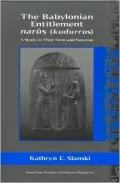
In this investigation into the form, function and historical significance of the Babylonian entitlement narus (steles), the author sheds new light on one of antiquity's most mysterious and elusive classes of artifact. More commonly referred to as kudurrus, these objects first came to the attention of western scholars in 1801 when the explorer Anton Michaux sold a polished black stone that he had discovered near Baghdad to the Bibliotheque National in Paris. In addition to her in-depth study of the setting of these objects and the inscriptions and relief sculptures carved on them, Slanski places the kudurrus squarely within the monumental tradition in Mesopotamia. This volume promises to be a significant contribution for Assyriologists and anyone interested in the history and artistic traditions of ancient Mesopotamia.Synopsis
Slanski (Near Eastern languages and civilizations, Yale U.) examines the some 160 fragments of Babylonian carved stones that are—incorrectly in her opinion—called kudurru, or boundary stones. Now scattered in museums worldwide, they date from the 14th to the seventh centuries BCE. The study is revised from her 1997 Ph.D. dissertation for Harvard University. Distributed in the US by the David Brown Book Company. Annotation ©2003 Book News, Inc., Portland, OR
Book Details
Published
March 1, 2003
Publisher
American Schools of Oriental Research
Pages
256
Format
Paperback
ISBN
9780897570602