
Girls & Women, Feminists - Biography, Women's History - United States, Fiction - General & Miscellaneous, Law, Women - Biography
Log in to track your reading progress.
Overview
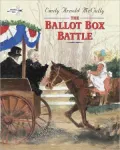
From Caldecott medalist Emily Arnold McCully comes the inspiring story of Cordelia, a young girl whose relationship with her neighbor, the great suffragist Elizabeth Cady Stanton, inspires her to a remarkable act of courage.
Editorials
Publishers Weekly -
On Election Day 1880, the women's rights activist Elizabeth Cady Stanton teaches her young neighbor a lesson in gumption. "McCully's art and story deliver [a relevant message] gracefully," said PW. Ages 5-8. Oct.Publishers Weekly -
Following her tribute to proto-feminist 19th-century millworkers in The Bobbin Girl, McCully weaves a story around Elizabeth Cady Stanton. It is Election Day in 1880, 32 years after Stanton organized the first women's rights convention in Seneca Falls, N.Y., yet 40 years before the 19th Amendment granted women the vote. The activist takes time out from writing The History of Woman Suffrage to give riding lessons to Cordelia, whose brother disdainfully states that she will not be a true horsewoman until she jumps a four-foot fence. Stanton tells Cordelia about her own childhood goals to be as "learned and courageous" as her only brother and to convince her father that she was as good as any boy. Her father's refusal to acknowledge her achievements "taught me to go on fighting. And I have!" Reluctantly accompanying her mentor to the polls, Cordelia watches as the election officials ridicule Stanton, who flings her ballot at the hand covering the slot in the box. And though Stanton's triumph on this day is hardly complete, Cordelia's is: goaded by her brother, the girl jumps onto her horse and sails over a high fence. In sometimes misty paintings that seem to fade in and out of focus, McCully deftly portrays two time periods, distinguishing Stanton's flashbacks with round-edged pictures seen as if through a telescope to the past. Stanton has a worthy message for contemporary girlsand boys, and McCully's art and story, aided by a succinct concluding note, deliver it gracefully. Ages 3-8. (Aug.)Children's Literature -
Younger children will thrill to Emily Arnold McCully's The Ballot Box Battle. McCully's shimmering watercolors and relatively short text dramatize an actual "battle," when Elizabeth Cady Stanton, suffrage leader, sought to cast her ballot in 1880 in Tenafly, New Jersey-and was turned away with taunts and jeers. Her young friend, fictional character Cordelia, watches sorrowfully and is finally moved to anger and spunky action when her brother and his friends chant, "No votes for pea-brained females!"School Library Journal
Gr 2-4History, the subtle and not-so-subtle oppression of women, and the redoubtable character of Elizabeth Cady Stanton are made real and alive in this colorfully illustrated story set in the summer of 1880. Cordelia loves to ride on Mrs. Stanton's old horse and hear the stories of her neighbor's own girlhood. Despite her efforts to ride and excel in Greek, young Elizabeth's only praise was to hear "Oh, my daughter, you should have been a boy!" Cordelia's brother puts her down in the same way when he makes fun of her desire to prove herself a courageous rider. On election day, the children accompany Mrs. Stanton on her yearly attempt to cast a vote in the local contests. Seeing her friend's courage in facing the taunts and scorn of the men gathered at the polls, and angry at the teasing of the local boys, Cordelia makes her own protest by taking the old horse over a four-foot fence in a daring and dangerous leap forward. McCully's richly hued, softly textured paintings beautifully evoke the late 19th-century era and the small-town world of Tenafly, NJ, where the widowed Stanton spent her last years. Skillfully weaving fact and story, The Ballot Box Battle offers a history lesson pleasingly framed in a story about an independent young girl. A full-page author's note gives further information on Stanton and on the creation of the book.Shirley Wilton, Ocean County College, Toms River, NJKirkus Reviews
The author of The Bobbin Girl (p. 230) offers another strong, admirable character in this encounter between Elizabeth Cady Stanton and a young neighbor. Every afternoon Cordelia comes over to care for Mrs. Stanton's horse in exchange for a riding lesson—plus a series of reminiscences to which she listens politely, if not always attentively. One day, after explaining how her strenuous but futile childhood efforts to win her father's respect taught her to keep on fighting, Mrs. Stanton invites Cordelia to come along to the polls as she quixotically tries yet again to vote. Her example before a jeering (as well as, in one or two cases, admiring) throng of men and boys inspires an act of courage in Cordelia. An author's note at the end separates facts and fictions.Like Michael Bedard's Emily (1992), this book gives readers a tantalizing, child's-eye view of an American original, a challenger of social norms and expectations. McCully's dark, vigorously brushed watercolors successfully evoke both period (1880) and personalities: Stanton is a glowering, formidable presence, while Cordelia, with her straight back, pinafore, and large hair ribbon is a poised, blonde soulmate to Mirette.
Book Details
Published
August 19, 1999
Publisher
Alfred A. Knopf
Pages
32
Format
Paperback
ISBN
9780679893127