
History of Economics, Literary Criticism - General & Miscellaneous, 19th Century British History - Victorian Era (1837-1901), Economics - General & Miscellaneous, Death & Dying - Sociocultural Aspects, English Fiction & Prose Literature - 19th Century - L
Log in to track your reading progress.
Overview
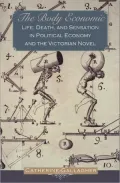
The Body Economic revises the intellectual history of nineteenth-century Britain by demonstrating that political economists and the writers who often presented themselves as their literary antagonists actually held most of their basic social assumptions in common. Catherine Gallagher demonstrates that political economists and their Romantic and early-Victorian critics jointly relocated the idea of value from the realm of transcendent spirituality to that of organic "life," making human sensations-especially pleasure and pain-the sources and signs of that value. The Body Economic explains how these shared views of life, death, and sensation helped shape and were modified by the two most important Victorian novelists: Charles Dickens and George Eliot. It reveals how political economists interacted crucially with the life sciences of the nineteenth century-especially with psychophysiology and anthropology-to produce the intellectual world that nurtured not only George Eliot's realism but also turn-of-the-century literary modernism.About the Author:
Catherine Gallagher is the Eggers Professor of English Literature at the University of California, Berkeley, and the author of several previous books
Editorials
Nineteenth-Century Literature
Gallagher's brilliance as an intellectual historian has always resided in her ability to show us how ideas that look different are really alike, and how ideas we tend to lump together are really different. . . . The Body Economic . . . is a gift to the intelligence of every student of nineteenth-century culture.— Rosemarie Bodenheimer
Modernism/Modernity
[B]rings the history of economics into the heart of modern literature and literary theory, showing how much modernism's anti-bourgeois presentation of sex owed to a complex century-long debate about wealth and poverty. It is a rare achievement.— Gordon Bigelow
[This] is an innovative and provocative book, brimming with fresh insights. . . . Gallagher's use of political economy to explain the most puzzling features of Dickens's novel is inspirational, and it will likely become a model for future studies.
— Silvana Colella
[B]rings the history of economics into the heart of modern literature and literary theory, showing how much modernism's anti-bourgeois presentation of sex owed to a complex century-long debate about wealth and poverty. It is a rare achievement.
— Gordon Bigelow
[This] is an innovative and provocative book, brimming with fresh insights. . . . Gallagher's use of political economy to explain the most puzzling features of Dickens's novel is inspirational, and it will likely become a model for future studies.
— Silvana Colella
Journal of Victorian Culture -
[An] astute and innovative reevaluation of the interplay between fiction and economic thought . . . [The Body Economic] represents a major contribution to literary studies and intellectual history.Field Day Review -
In a stunningly innovative gesture, Gallagher points out that the thin-blooded political economists and the warm-hearted Romantic organicists of early nineteenth-century Britain had a good deal more in common than is generally supposed.Nineteenth-Century Literature -
Gallagher's brilliance as an intellectual historian has always resided in her ability to show us how ideas that look different are really alike, and how ideas we tend to lump together are really different. . . . The Body Economic . . . is a gift to the intelligence of every student of nineteenth-century culture.Modernism/modernity -
[B]rings the history of economics into the heart of modern literature and literary theory, showing how much modernism's anti-bourgeois presentation of sex owed to a complex century-long debate about wealth and poverty. It is a rare achievement.Modern Language Review -
In her commanding and authoritative new study Catherine Gallagher['s] . . . The Body Economic will doubtless become required reading for anyone seeking to understand the complex lines of affiliation and resistance between economic theory and the literary text in the mid-Victorian period.Nineteenth Century Studies -
[This] is an innovative and provocative book, brimming with fresh insights. . . . Gallagher's use of political economy to explain the most puzzling features of Dickens's novel is inspirational, and it will likely become a model for future studies.[An] astute and innovative reevaluation of the interplay between fiction and economic thought . . . [The Body Economic] represents a major contribution to literary studies and intellectual history.
— Margot Finn
In a stunningly innovative gesture, Gallagher points out that the thin-blooded political economists and the warm-hearted Romantic organicists of early nineteenth-century Britain had a good deal more in common than is generally supposed.
— Terry Eagleton
Many of Gallagher's local observations and textual analyses are stunningly perceptive and original. . . . Gallagher's treatments of the four novels she examines in detail are also complex and rewarding. Her analysis of Daniel Deronda, which turns on the resemblance between Jevon's marginal utility formula and Eliot's exploration of Gwendolen's and Elit's storries about being redundant—'a final increment' that can never be as desirable as its predecessors—is a tour de force that illuminates the novel in fascinating ways.
With admirable economy and a clear sense of purpose, The Body Economic explores and collapses the gulf popularly held to exist between the values and mindsets of post-Enlightenment political economists, represented here by Bentham and Malthus, and those of nineteenth-century imaginative novelists, here represented in the mid-Victorian phase by Dickens, and in the late, by George Eliot. . . . [An] original and considerable accomplishment.
In her commanding and authoritative new study Catherine Gallagher['s] . . . The Body Economic will doubtless become required reading for anyone seeking to understand the complex lines of affiliation and resistance between economic theory and the literary text in the mid-Victorian period.
— Roger Ebbatson
Book Details
Published
November 21, 2005
Publisher
Princeton, N.J. : Princeton University Press, c2006.
Pages
224
Format
Hardcover
ISBN
9780691123585