
Epidemiology & Biostatistics, Public Health & Preventive Medicine, Biology - Microbiology, Diseases & Disorders - General & Miscellaneous, Medical Sociology, Biology - General & Miscellaneous, Microbiology
Log in to track your reading progress.
Overview
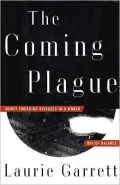
Unpurified drinking water. Improper use of antibiotics. Local warfare. Massive refugee migration. Changing social and environmental conditions around the world have fostered the spread of new and potentially devastating viruses and diseases--HIV, Lassa, Ebola, and others. Laurie Garrett takes you on a fifty-year journey through the world's battles with microbes and examines the worldwide conditions that have culminated in recurrent outbreaks of newly discovered diseases, epidemics of diseases migrating to new areas, and mutated old diseases that are no longer curable. She argues that it is not too late to take action to prevent the further onslaught of viruses and microbes, and offers possible solutions for a healthier future.In this gripping, often harrowing study, Laurie Garrett takes readers on a 50-year journey through the world's battles with microbes, and examines the conditions that have culminated in recurrent outbreaks of newly discovered diseases, epidemics of diseases migrating to new areas, and mutated old diseases that are no longer curable. A New York Times Notable Book in 1994.
Editorials
Publishers Weekly -
Documenting the plausible threat of major new worldwide epidemics, as well as eruptions of recently discovered diseases, Garrett's gripping and frightening report sounds a wake-up call to the planet. Wars, sexual promiscuity, inept public-health efforts and development schemes that disrupt ecosystems are some of the factors she says contribute to the alarmingly rapid mutation of viruses, the pandemics sweeping through the animal world, and the spread of human diseases to new areas. Health and science writer for New York Newsday, Garrett discusses the tremendous increase in AIDS and HIV infection across Asia, outbreaks of the incredibly lethal Ebola virus in Africa, and the spread of diseases via human technologies (such as tampons contributing to toxic shock syndrome). Her first-rate investigation concludes with a call for a global early warning system to rapidly detect new diseases and drug-resistant strains. BOMC, QPB and Natural Science Book Club selections.Library Journal
Medical journalist Garrett presents a history of epidemiology in a format that is educational, moving, and terrifying. She skillfully illustrates the role of ecology, politics, and economics in worldwide healthcare and uses numerous examples to emphasize the need for a global perspective in the management of disease. Yellow fever, malaria, ebola, lassa fever, AIDS, legionnaires' disease, toxic shock syndrome-she discusses in depth the search for the causes of these and many other diseases. The tranquil days following the discovery of antibiotics are gone as drug-resistant strains of disease-causing organisms continue to reappear. The message is clear: we must drop our complacency and learn from past epidemics or face the consequences. An extremely readable style and exhaustive notes make this fascinating reading for general readers and scholars alike. Highly recommended. [See also Richard Preston's The Hot Zone, LJ 8/94.-Ed]-Tina Neville, Univ. of South Florida at St. Petersburg Lib.Booknews
Based on international field research and extensive interviews with experts in virology, molecular biology, disease ecology and medicine, Garrett (health and science writer and former science correspondent for National Public Radio) investigates newly identified viruses such as HIV, HIV-II and the mysterious Ebola; old viruses in new locations, such as hantavirus and dengue; and mutant strains of old diseases--and examines the relationship between the spread of disease, sociology, politics and science. Annotation c. Book News, Inc., Portland, OR (booknews.com)William Beatty
This might have been a sensation-seeking book that stirs things up briefly, then quickly disappears, but Garrett has studied the scientific and popular literature, interviewed many knowledgeable individuals, and constructed a cogent, well-documented, far-reaching argument. The main points of that argument include the fact that careless use of antibiotics has led to the growth of drug-resistant strains and species of microbes, the fact that microbial mutations are not necessarily random events, and the facts of the influences of urbanization and increasing military expenditures on public health. Further, she cites the roles of global warming, pollution of oceans, and shortsighted politicians in helping spread disease. She makes all her points about those phenomena through compelling, detailed epidemiological examples. The major injunction arising from her argument is that, because humanity is sitting on a powder keg of disease, every country must provide adequate funds or cooperative support for the fieldwork and research aspects of public health and preventive medicine. If they do not, "Homo sapiens" will become an endangered species.From Barnes & Noble
An alarming look at the last 50 years and our destiny in the face of humanity's nightmare--the eruption of newfound viruses, mysterious microbes, and a global epidemic of immunodeficiency.Book Details
Published
October 1, 1994
Publisher
New York : Farrar, Straus and Giroux, c1994.
Pages
750
Format
Hardcover
ISBN
9780374126469