
Native North American Peoples - Religion, Native North American Peoples - General & Miscellaneous, Nature, Philosophy of, Public Opinion - Regional, Public Opinion - Ethnic & Religious, Popular Culture - General & Miscellaneous, Human Ecology
Log in to track your reading progress.
Overview
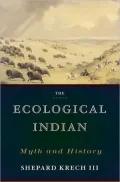
A startling look at historical truths and romantic falsehoods about Native Americans and their relationship to nature. The idea of the Native American living in perfect harmony with nature is one of the most cherished contemporary myths. It has provided an important corrective to individual and corporate carelessness towards the natural world. But is there truth in this larger-than-life image? Not very much, according to Shepard Krech. The Ecological Indian surveys North American environmental history to explore the relation between humans and the rest of nature before and after the arrival of Europeans, addressing such fascinating questions as: Were Pleistocene-era humans responsible for the extinction of large mammals like the mastodon? Did the Hohokam of Arizona destroy their society by overirrigating and ultimately oversalinating their crops? What role did Native Americans play in the near-extinctions of the deer, the beaver, and the buffalo? How did they use fire? Was the natural "Eden" that awed the first European visitors just a feature of very low-population density? Shedding invaluable light both on conservation and ecology in Native America and on fierce contemporary debates, this groundbreaking book is essential reading for all who care about the environment, humans, and their history together.Editorials
Publishers Weekly -
The image is gripping: a handsome American Indian with a sad, tear-filled eye offers the simple message, "Pollution: It's a Crying Shame." This 1970s anti-pollution advertisement, which reached millions of people, helped entrench the notion that Indians treated the land kindly and white invaders spoiled it. Not so, says anthropologist Krech, in this compelling, if somewhat incomplete, examination of the historical truths and romantic myths about Native Americans and their relationship with nature. Acknowledging that Indians clearly possessed vast knowledge of their environment, Krech contends that this knowledge was often merged with a religious cosmogony that left little room for conservation as it is understood today. Indians may have treated the individual animals upon which they preyed with great respect in order to avoid offending their spirits, but this view did not prevent occasional overhunting or depletion of resources, according to Krech. If the New World seemed like a rich Eden to European immigrants, Krech contends it was because the populations of Native Americans were too small to have made much of a difference in their environments before they were overtaken by the newcomers' resource-based economy. To prove his points, Krech closely examines the role Native Americans played in a variety of environmental histories, from Pleistocene extinctions to the demise of the buffalo. Yet he overlooks what was one of the greatest single animal-based economies of precontact times, the vast subsistence salmon fisheries of western North America. (Aug.) Copyright 1999 Cahners Business Information.Library Journal
A popular question of debate has centered on the Native American relationship to the environment. Were they the first environmentalists, conservationists who neither wasted nor altered their natural resources? Krech (anthropology, Brown Univ.) addresses this cherished American myth by reviewing archaeological, oral, and written records and applying them to a few specific cases. The Native Americans, like all peoples, altered their environments, responded to climatic changes, adjusted to times of feast and famine, and adapted to the new economic forces introduced by Europeans. They were not Noble Savages, nor was North America the Eden that Europeans recorded. Europeans saw what they wanted to see, neglecting the native histories, cultures, and religions that would have helped them gain an accurate representation of this "new land." Krech asks questions to spark new debate on the image of the "ecological Indian." A thought-provoking book; recommended for all libraries.--Patricia Ann Owens, Wabash Valley Coll., Mt. Carmel, IL Copyright 1999 Cahners Business Information.Booknews
Krech (anthropology, Brown U.) treats such provocative issues as whether the Eden in which Native Americans are viewed as living prior to European contact was a feature of native environmentalism or simply low population density; indigenous use of fire; and the Indian role in near-extinctions of buffalo, deer, and beaver. He concludes that early Indians' culturally-mediated closeness with nature was not always congruent with modern conservation ideas, with implications for views of, and by, contemporary Indians. Annotation c. Book News, Inc., Portland, OR (booknews.com)Detroit News
Krech carefully separates romance from data.... This book is what good science should be.Nicholas Lemann
Krech is more than just a conventional-wisdom overturner; he has a serious larger point to make. It is his view that concepts like ecology, waste, preservation, and even the natural--as distinct from the human--world are entirely anachronistic when applied to Indians in the days before the European settlement of North America.—The New Yorker
Wall Street Journal
The book's] subtitle- "Myth and History"- whets the appetite for revisionism... [but] Krech evidently has no axes to grind.Washington Post
In The Ecological Indian, anthropologist Shepard Krech sets off into the dangerous but compelling territory of Native American identity.... [Krech] offers us a more complex portrait of Native American peoples, one that rejects mythologies, even those that both European and Native Americans might wish to embrace.Kirkus Reviews
Iron Eyes Cody, the Weeping Indian, was a fraud, and so, says Krech, is the image of the American Indian as protoecologist. When, in 1971, Keep America Beautiful used Cody (an Italian-American who passed himself off as a Native American) as its antipollution icon, it furthered a then-emerging view of American Indians as somehow better people vis-à-vis the land than the Europeans who supplanted them. That view gained popularity in later years, helped along by advocates like Vine Deloria, a Sioux historian and attorney, who said, •The Indian lived with his land. The white destroyed his land. He destroyed the planet Earth.• But, writes Brown University anthropologist Krech, there is little historical basis for the notion that Indians were any more responsible caretakers of the land and its nonhuman denizens than were contemporary Europeans. While this image, he writes,Book Details
Published
October 6, 1999
Publisher
New York : W.W. Norton & Company, c1999.
Pages
318
Format
Hardcover
ISBN
9780393047554