
Middle East - Ethnic & Race Relations, Middle East - Diplomatic Relations with the U.S., 20th Century American History - Relations - General & Miscellaneous, Iraq - History, Iraqi Politics & Government, Iraq War, 2003
Log in to track your reading progress.
Overview
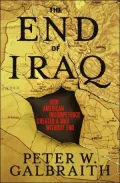
The End of Iraq -- definitive, tough-minded, clear-eyed, describes America's failed strategy toward that country.Editorials
David Ignatius
While Bush administration officials warn of the dangers of giving up on a united Iraq, Galbraith argues that the worst has already happened: The United States has failed to create a stable post-Saddam Hussein government; a bloody civil war is already raging; and the longer the United States tries to maintain the fiction that the Iraqi killing ground is a viable nation, the more people will get killed. Better that Iraq break into its constituent pieces -- an independent Kurdistan in the north, an Iranian-dominated Shiaistan in the south, a Sunnistan in the northwest.— The Washington Post
Publishers Weekly
Galbraith, a leading commentator on Iraq thanks to his recent articles in the New York Review of Books, presents a clear-eyed and persuasive case against the Bush administration's nation-building project there. As a former U.S. diplomat with long experience in Iraq, he offers an insider's view of the American occupation's failures--the poor preparation for post-invasion chaos, the cluelessness about Iraqi politics, the incompetence and corruption of the occupation authority--while advancing a deeper critique. With Saddam's dictatorship and the Baathist party and army that supported it gone, he contends that Iraq is irrevocably splitting into a pro-American Kurdistan in the north, a pro-Iranian Shiite south and an ungovernable Sunni center. America "cannot put the country back together again and it cannot stop the civil war," he insists. Deeply skeptical of attempts to reunify the Iraqi state, he proposes that the U.S. withdraw from Arab Iraq and "facilitate an amicable divorce" between the fractious sections. Galbraith advised the Iraqi Kurds during recent constitutional negotiations and is palpably sympathetic to their national aspirations; his argument sometimes feels like a brief for Kurdish separatism. Still, Galbraith's authoritative grasp of the issues and his cogent, forthright call for disengagement ensure that the book will move into the center of the debate over American policy in Iraq. (July 17) Copyright 2006 Reed Business Information.Library Journal
These books offer broad critiques, from differing perspectives, of U.S. policy and conduct in Iraq. Galbraith (senior diplomatic fellow, Ctr. for Arms Control & Non-Proliferation) emphasizes the conflict between the reality of a deeply divided post-Saddam Iraq and the Bush administration's assumption that a unified democratic state might be cobbled together. Fawn (international relations, Univ. of St. Andrews, Scotland; Global Responses to Terrorism) and Hinnebusch (international relations & Middle East politics, Univ. of St. Andrews, Scotland; The International Politics of the Middle East and Syria) offer a collection of original pieces that examine policy and the political impact of the war on the states involved, along with consideration of such themes as international law and ethics, Islamic militancy, and the war's "lessons." Their book is especially useful in demonstrating the war's divisive impact on the international community. For example, British war involvement is said to arise from the country's special relationship with the United States and the "new Labour [Party] worldview," a position at variance with Franco-German support for the international legitimacy of the UN and the sense of solidarity the former communist states of Central and Eastern Europe share with the United States. Middle Eastern states show similar cleavage, from Israel's support, to what is seen as Iran's ambivalence, and Syria's defiance. The treatment of these and other states represents a neglected aspect of the war, although the thematic chapters sacrifice analysis for useful essayistic breadth. A chapter on the insurgency offers a theme that converges with Galbraith's work in that both view the failure to secure Iraq immediately after Saddam's defeat in 2003 to have been decisive in explaining the current imbroglio. Moreover, as a former top Senate staffer and diplomat, Galbraith supports his accusations of U.S. incompetence in conducting the war and the catastrophic assumption of an easy occupation with his extensive personal experience in Iraq, especially with the Kurdish leadership. He finds the country in the throes of civil war and recommends partition with a residual U.S. force in an independent Kurdistan. Reconciling Turkey with such a state, along with separate Sunni and Shi'ite "regions," as the author recommends, also implies certain challenging assumptions. These two fine books help sharpen our perspective on these critical problems and may be confidently recommended for public and academic libraries, although the former should give priority to Galbraith's book. [For Galbraith's book, see Prepub Alert, LJ 2/15/06.]-Zachary T. Irwin, Behrend Coll., Pennsylvania State Univ., Erie Copyright 2006 Reed Business Information.From the Publisher
“A clear-eyed and persuasive case against the Bush administration's nation-building project.” —-Publishers Weekly Starred ReviewBook Details
Published
July 11, 2006
Publisher
New York ; Simon & Schuster, c2006.
Pages
272
Format
Hardcover
ISBN
9780743294232