
Quantum Physics, Inorganic Chemistry, Mathematicians & Logicians - Biography, Mathematics - Group Theory
Log in to track your reading progress.
Overview
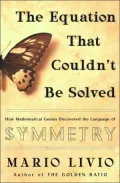
"Over the millennia, mathematicians solved progressively more difficult algebraic equations until they came to what is known as the quintic equation. For several centuries it resisted solution, until two mathematical prodigies independently discovered that it could not be solved by the usual methods, thereby opening the door to group theory. These young geniuses, a Norwegian named Niels Henrik Abel and a Frenchman named Evariste Galois, both died tragically. Galois, in fact, spent the night before his fatal duel (at the age of twenty) scribbling another brief summary of his proof, at one point writing in the margin of his notebook "I have no time."" The story of the equation that couldn't be solved is a story of brilliant mathematicians and a fascinating account of how mathematics illuminates a wide variety of disciplines. In this book, Mario Livio shows in an easily accessible way how group theory explains the symmetry and order of both the natural and the human-made worlds.Editorials
From Barnes & Noble
On the night before his fatal duel, 20-year-old Evariste Galois (1811-32) scribbled madly in his notebook, so frantically that he wrote in the margins, "I have no time. I have no time." This impetuous youth did not live to witness his triumph, but posterity would recognize his elegant proof as the conclusion of a 4,000-year mathematical quest. In The Equation that Couldn't Be Solved, Mario Livio tells the story of the search for the quintic equation and the birth of group theory, the "language" that describes symmetry.Publishers Weekly
The idea of symmetry has been heavily deployed in recent science popularizations to introduce advanced subjects in math and physics. This approach usually backfires-mathematical symmetry is much too difficult for most laypeople to understand. But this engaging treatise soft-pedals it in a crowd-pleasing way. The title's formula is the "quintic" equation (involving x raised to the fifth power), the analysis of which gave rise to "group theory," the mathematical apparatus scientists use to explore symmetry. Inevitably, the author's attempts to explain group theory and its applications in particle physics and string theory to a general audience fall sadly short, so readers will just have to take his word for the Mozartean beauty of it all. Fortunately, astrophysicist Livio (The Golden Ratio) keeps the hard stuff to a minimum, concentrating instead on interesting digressions into human interest (e.g., the founder of group theory, Evariste Galois, was a revolutionary firebrand who died in 1832 at age 20 in a duel over "an infamous coquette"), pop psychology (women have more orgasms when their partners have symmetrical faces), strategies for finding a soul mate and some easy math puzzles readers might actually solve. The result is a somewhat shapeless but intriguing excursion. Photos. Agent, Susan Rabiner. 50,000 first printing; 9-city author tour. (Sept.) Copyright 2005 Reed Business Information.Library Journal
Livio (former head, science division, Hubble Space Telescope Science Inst., Johns Hopkins Univ.) has written a summary of the origins of group theory and symmetry for lay readers. Taking the approach of his earlier books (The Golden Ratio; The Accelerating Universe), he attempts to bring to nonmathematicians a broad discussion of group theory and aesthetics. No other book covers such a wide range of topics: biographical information on Niels Henrik Abel and Evariste Galois, introductory concepts and problems in group theory, and applications of group theory to broader disciplines-all in one volume. The generously illustrated text has many visual aids and photos, as well as detailed chapter notes with lists of recommended literature sources and a Galois family tree. For the mathematically inclined, Livio also includes more fully explained problems in a series of appendixes. Highly recommended for large public and academic libraries. [See Prepub Alert, LJ 5/15/05.]-Elizabeth Brown, Binghamton Univ. Libs., NY Copyright 2005 Reed Business Information.Kirkus Reviews
Evolution favors symmetry. So do people. So does just about everything in the universe. Astrophysicist Livio (The Golden Ratio, 2002, etc.), no slouch at mathematics himself, crafts an entertaining exploration of how the laws of symmetry have shaped our chaotic little world, and how they inform our appreciation of art and music. One of his great heroes is someone whom mathematicians with a historical bent know well: the French wunderkind Evariste Galois, generally held to be one of the great minds in a field dominated by great minds and the progenitor of what is now called group theory. Galois (1811-32) was a brilliantly troubled kid who loved mathematics, which returned the favor, and a woman who did not. The young genius died in a duel whose occasion has long mystified historians. His last, supremely memorable, words were: "Don't cry, I need all my courage to die at twenty." Before he died, however, Galois impacted the course of history. Among other accomplishments, he formed a new branch of algebra known as Galois theory. Livio's history is elegant but, suffice it to say, not for the innumerate or the scientifically faint of heart: it helps to know something of quadratic equations and other high-order concepts that would have been second nature to Galois but are harder going for us lesser souls. Galois's research, Livio writes, helped turn other scientists to thinking about symmetry, which led to Einstein and quantum theory and other wonders of the modern age. It's a complicated tale, with learned asides on the nature of creativity and, in the bargain, a convincing argument many years after the fact concerning the identity of Galois's killer. A lively companion to Bulent Atalay's Mathand the Mona Lisa (2004), John Barrow's Book of Nothing (2001) and other recent popular studies in mathematical thought. First printing of 50,000Book Details
Published
September 19, 2005
Publisher
New York : Simon & Schuster, c2005.
Pages
368
Format
Hardcover
ISBN
9780743258203