
Foreign Economic Relations - United States, 20th Century American History - Economic Aspects - Post World War II, United States Studies - General & Miscellaneous, Free Trade, United States - Economic History, Labor Studies - General & Miscellaneous, Worki
Log in to track your reading progress.
Overview
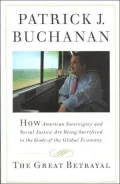
In The Great Betrayal, Buchanan charges the architects of NAFTA and GATT with selling out the middle class and turning their backs on the nation. As the voice of populist conservatism, he speaks to the desperation of the millions of Americans who have lost their jobs as a result of the free-trade policies of the Global Economy. He shows how by exporting jobs to Asia and Mexico, the corporate elite is destroying the American dream and profiting from the exploitation of sweatshop labor. Abandoned by their government, American workers are being forced to compete with cheap Third World labor and, inevitably, are losing out. Basing his arguments on the principles of our Founding Fathers and using real-life stories to illustrate the plight of the working class, Buchanan raises an impassioned call to arms. He offers a "new economic nationalism" and invites a battle for the heart and soul of the Republican Party in 2000 on the issues of national sovereignty and social justice. Republicans, neoconservatives, and Democrats cannot let his charges go unanswered.Editorials
Library Journal
Everyone's favorite right winger clobbers the global economy.Kirkus Reviews
This book is exactly what you expect it to be. As a political adviser, journalist, and presidential candidate, Buchanan is no shrinking violet, and after only a few pages, the reader of this volume will wonder if he writes his drafts in all caps. Whatever oneþs politics, it is impossible not to marvel at Buchanan's energy, individuality, and certainty about the world. The unique thing about Buchanan is not that he defies labeling, but rather that so many borderline oxymoronic labels apply: populist Republican partisan; strident nostalgic nationalist; social conservative intent on stirring things up. And, of course, there are the villains that populate Buchanan's world: "cloistered academics," "new-class journalists," economists, elites, Washington, D.C., and, of course, liberals. But while the effects of an odd selective vision (magnifying what he wants to see and obscuring complicating factors) are everywhere, it would be a mistake to read this book only for the entertainment value. Buchanan begins with a harangue about free traders killing America, follows with a protectionist's history of America, and concludes with recent events that indicate the forces of good may yet triumph over the evil of free trade. While trade is the surface theme throughout, however, the deeper argument reveals more about Buchanan's politics. But what is it? He claims to be writing about economic justice, "closing the divisions and easing the tensions in society that emanate from the economic order," but this claim is suspect. At best such concerns are addressed indirectly while carefully skirting genuinely redistributive policies. A more likely candidate is his distinction between nationalistsand globalists, ultimately a cultural and intellectual rather than an economic division. This seems to be the culture war Buchanan wants to fight and where he toys with moving beyond strong arguments to demagogic rhetoric. Inspiring and infuriating. (illustrations, not seen)Book Details
Published
April 1, 1998
Publisher
Boston : Little, Brown, c1998.
Pages
376
Format
Hardcover
ISBN
9780316115186