
Great Britain - Espionage, Revolutionaries - Biography, British Poets - Literary Biography, Spies - Biography
Log in to track your reading progress.
Overview
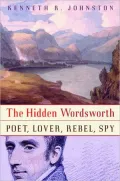
In this account, Kenneth R. Johnston portrays a Wordsworth different in crucial ways from the one that the poet intended us to know. Taking advantage of unprecedented access to government archives in England and France, family papers, school and university records, and intimate letters, he brings little-known aspects of Wordsworth's life and character to the fore. With its urban revolutions and Alpine scenery, French mistresses and passionate sisters, secret agents, aristocratic ogres, and furious guardian uncles, The Hidden Wordsworth unfolds a life that Byron might have envied. Johnston relates Wordsworth's attempt to cover up these personal details, his systematic and successful efforts to hide his "juvenile errors" from his contemporaries and from history. But they did not disappear: many of them stare us in the face from the lines of his greatest poetry, like purloined letters we have not seen because they are too obvious.Editorials
Hermione Lee
...Johnston's staggering industriousness did draw me in, though he did not make me like Wordsworth any more....Johnston never lets us see Wordsworth in splendid isolation but always in the thick of his times....[The book's] most thoughtful and impressive aspect....is its account of a young man's self-transformation into a poet.—New York Times Book Review
Publishers Weekly -
Wordsworth tried to evade close scrutiny of his life by creating a more sanitized version of it in "The Prelude." If this study of almost 1,000 pages is anything to judge by, there's much more to Wordsworth than previously imagined. Johnston delves deep into the poetry and historical sources. Much of what is new is the result of research into government archives in Britain and France, Wordsworth's university records and personal letters of Wordsworth's intimates. Although the volume concentrates only on Wordsworth's early life (approximately the same period covered by "The Prelude"), the young Wordsworth emerges as a fiery soul, one perfectly situated to shine among his Romantic counterparts. Johnston shows that Wordsworth was more closely aligned with radical Jacobins than has been previously thought. We also learn that financial difficulties may have led Wordsworth to serve the Foreign Office as a minor spy on his trip to Hamburg. Also, Johnston puts to rest the idea that Wordsworth was uninterested in sex by discussing his familiarity with prostitutes at Cambridge and revealing a small but intriguing list of Wordsworth's love interests. But Johnston tends to wallow in encyclopedic detail of questionable interest (e.g., on November 30, 1791, Wordsworth changed money "at the excellent rate of 643 livres for [20 pounds]"). Making the book doubly dense are Johnston's frequent comparisons of The Prelude to historical fact, which can be useful, but seem like a separate book altogether. Still, there is plenty of interesting, fresh detail among the expendable bits.Library Journal
From the Lyrical Ballads to the epic poem "The Prelude," Wordsworth expresses the "natural supernaturalism" and the radical individualism of the Romantic movement. In exhaustive, and sometimes exhausting, detail, Johnston (English, Indiana Univ.) combines newly available materials and close readings of the Prelude to chronicle Wordsworth's life from 1770 to 1807. Johnston offers a portrait of the young Wordsworth as a master at hiding his self-identity in his poetry and convincingly demonstrates that the gaps in Prelude point to chapters in Wordsworth's life, e.g., his affair with Annette Vallon, who bore him a child, and the mysterious silence surrounding the "five long years" (1793-98), which the poet cleverly concealed from his public. With over 900 pages dedicated to Wordsworth's early life, Johnston's book exemplifies all the excess of contemporary scholarly, and popular, biography. Yet his often riveting prose and his engaging readings of the poems will lure devotees of Wordsworth and British Romanticism. -- Henry L. Carrigan Jr., Westerville P.L., OHHermione Lee
...Johnston's staggering industriousness did draw me in, though he did not make me like Wordsworth any more....Johnston never lets us see Wordsworth in splendid isolation but always in the thick of his times....[The book's] most thoughtful and impressive aspect....is its account of a young man's self-transformation into a poet.— The New York Times Book Review
Kirkus Reviews
As admirers of William Wordsworth's epochal Lyrical Ballads celebrate that volume's bicentennial, this conscientious yet surprise-filled life of the poet will deepen their appreciation of his accomplishments. Johnston (English/Indiana Univ.) concentrates on Wordsworth's (1770-1850) young adulthood, linking the poetry of his "great decade" (1797-1807) to his political and sexual coming-of-age during the Age of Revolution. Such links between Wordsworth and his tumultuous times are not new. But Johnston judiciously presents what was already known (at least to scholars) while uncovering striking new facets of Wordsworth's life, some heretofore buried in archives, some hidden in plain sightþin the lines of his poetry, for example. Johnston's opening chapters detail the Wordsworth family's situation as agents of powerful landed interests and the future poet's school days amid the natural wonders of England's Lake District. Orphaned, the teenage Wordsworth became the ward of conservative family elders against whom he rebelled. His studies became increasingly desultory, his extracurricular rambles more adventurous. In 1790, he left Cambridge University to travel in Europe, where he exulted in the climate of revolution. Wordsworth then lived in France for a time, fathering a child out of wedlock. Back in England, he became an intimate of London Radical circles; Johnston suggests that he returned yet again to France amid the Terror to visit his threatened mistress and their child. Johnston's chapters on Wordsworth's financial woes and resulting rapprochement with Britain's conservative ruling elite feature a convincingþalthough sure to be controversialþargument that Wordsworthserved as a British agent in Germany in 1799. Meanwhile, Johnston explores Wordsworth's relations with his sister, Dorothy, with Samuel Taylor Coleridge, and with the other companions who supported him as he fashioned himself into the epic poet of the 1805 þPrelude.þ Although imposing in its length and occasionally ponderous in its manner, this epic biography is full of romance, rebellion, and intrigue, interleaved with expert glosses on many of history's most intriguing poems.Book Details
Published
June 22, 1998
Publisher
New York : W.W. Norton, c1998.
Pages
960
Format
Hardcover
ISBN
9780393046236