
Southeast Asia - Politics & Government, Political Prisoners - Biography, Burma (Myanmar) - History, Democracies & Republics - General & Miscellaneous
Log in to track your reading progress.
Overview
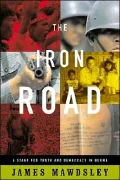
A startling account of an evil regime and one young man's efforts to defy it.Twenty-eight-year-old James Mawdsley spent much of the past four years in grim Burmese prisons. The Iron Road is his story, and the story of the regime that jailed him, the way it jails, tortures, and kills hundreds of Burmese each day.
Mawdsley was working in New Zealand when he learned about the struggle of Daw Aung San Suu Kyi, the Burmese Nobel laureate who is under house arrest. Outraged, he went to Burma, staged a one-man protest, and was jailed.
There his own amazing story begins. He is tortured, interrogated, released, jailed again. He turns his incarceration into a contest of wits -- going on a hunger strike, toasting the year 2000 with a cigar and "prison champagne," and requesting "1 packet of freedom, 1 bunch human rights, and 2 bottles of democracy." At the same time, he asks himself: What leads those of us in peaceful democracies to ignore others' suffering, just because it is happening "over there," to "them"?
James Mawdsley is a hero in a generation said to lack heroism. The Iron Road -- named for a torture in which skin is scraped from bone with a piece of iron -- is an urgent call for an end to human rights abuses in Burma and is a keen analysis of the totalitarian mind-set. And it is the story, at once moving and terrifying, of how one person can further the cause of justice through sheer will and determination.
Editorials
Publishers Weekly
In his first book, Mawdsley painstakingly describes his nearly unimaginable experiences as a political prisoner in Burma, recalling almost matter-of-factly the cruelty, deprivation, sorrow, horror and bureaucratic stupidity he endured, and his calculated opposition to authority. Three times he set himself up for arrest in Burma during the 1990s in support of the democratic movements that fought the repressive military junta. In a thorough but occasionally meandering narrative, the author vividly recounts sacrifice and heroism little known in the West. He tells of the brave and generous Burmese revolutionaries supporters of the National League for Democracy, which overwhelmingly won a 1990 election that was disregarded by the junta who daily faced the threat of encountering the larger, better-armed government forces. He also takes the reader inside his own mind, that of a quiet revolutionary who challenged authority by demanding his rights to food, books and letters and by calling for humane treatment for his fellow prisoners. Mawdsley also recounts his evolution from angry advocate of justice to a Christian armed with God's love (though as a Brit, he doesn't describe himself as "born-again"). His use of British terms may briefly befuddle some American readers. Yet his story of personal commitment to a struggle on the other side of the planet and of the Burmese who give their lives for that struggle buttresses everyone but despots and their minions. Photos and maps. (Aug.) Copyright 2002 Cahners Business Information.Library Journal
Englishman Mawdsley's passionate narrative stridently calls attention to the chronic abuse of human rights by the Burmese state. On three occasions, Mawdsley penetrated the Burmese border to demonstrate publicly on behalf of Burmese political freedom and elicit worldwide response through his arrest. He was immensely successful, inspiring efforts by the United Nations, the Vatican, and the governments of the United States, the United Kingdom, and Australia to address the Burmese situation. Mawdsley's narrative and diary excerpts describing his experiences in solitary confinement form a significant subplot, and it is especially instructive to see some of his early na vet give way to a sense of realpolitik as his imprisonment lengthened. A young man from a broken home who dropped out of university and failed in an attempted suicide, Mawdsley has clearly grown into a noble cause on which to focus his life. It is this vision, related in simple, sharply etched prose, that drives his compelling account. Recommended for all libraries John F. Riddick, Central Michigan Univ. Lib., Mt. Pleasant Copyright 2002 Cahners Business Information.Booknews
Mawdsley, a human rights activist associated with the organization Christian Solidarity Worldwide, spent 14 months in a Burmese jail, finally being released in the year 2000. In this memoir he recalls his travels to Burma, his growing involvement in the Burmese democracy movement, his political protests against the Burmese government, his decision to risk jail, and his time in the prison. Annotation c. Book News, Inc., Portland, OR (booknews.com)Kirkus Reviews
British human rights activist Mawdsley’s compelling debut chronicles his opposition to the Burmese military regime. Unfulfilled by student life, the author left school in 1993, at age 20, and relocated to Southeast Asia. He became interested in the plight of Burmese Nobel Laureate Daw Aung San Suu Kyi, whose democratic political party overwhelmingly won national elections in 1988 but whose victory was rejected by the military. Daw Aung San Suu Kyi was placed under house arrest, and many of her followers were killed or driven into exile. Mawdsley’s first contacts were with student exiles from the Burmese democracy movement who worked from Bangkok to assist sympathizers still living at home. He became an English teacher at one of the villages inside the border but soon graduated to more visible and dramatic forms of support, staging one-man protests and distributing antigovernment cassette tapes and leaflets. In and out of trouble with the Burmese government, Mawdsley ultimately chose to become a political prisoner, hoping that the detention of a British citizen would arouse support and concern in the West. The government was easily provoked; he was arrested, quickly tried, and sentenced to 17 years for, among other things, breaking a law against breaking the law. The author’s willingness to goad his captors and remind them of their illegitimacy even as he was interrogated and tortured seems at times more suicidal than courageous; much as readers will admire Mawdsley’s daring, they’ll also notice he’s a bit of a zealot. But it’s clear that this game of wits partly enabled him to survive four years in captivity. Coming at a time when the relationships between Western democracies andpolitically troubled developing nations have been cast into stark relief by the "war on terrorism," his account deserves a wide audience. Tightly written, at times cinematic: a stirring example of individual activism that shows why large democracies must aid and encourage smaller ones.Book Details
Published
August 1, 2002
Publisher
New York : North Point Press, 2002.
Pages
416
Format
Paperback
ISBN
9780865476370