
British Authors - 20th Century - Literary Biography, British Authors - 19th Century - Literary Biography
Log in to track your reading progress.
Overview
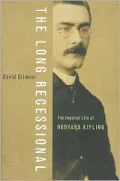
"Rudyard Kipling was a unique figure in British history, a great writer and a great imperial icon. He won the Nobel Prize for Literature, he added more phrases to the language than any man since Shakespeare, yet he was also the Apostle of the British Empire, a man who incarnated an era for millions of people who did not normally read poetry." "A child of the Victorian age of imperial self-confidence, Kipling lived to see the rise of Hitler threaten his country's existence. The laureate of the Empire at its apogee, he foresaw that its demise would soon follow his death. His great poem 'Recessional' celebrated Queen Victoria's Diamond Jubilee in 1897; his last poems warned of the dangers of Nazism. The trajectory of his life matched the trajectory of the British Empire from its zenith to its final decades. He himself was transformed from the apostle of success to the prophet of national decline, a Cassandra warning of dangers that successive governments refused to face." Previous works on Kipling have focused on his writing and on his domestic life. This is the first book to study his public role, his influence on the way Britons saw both themselves and their Empire. Based on extensive research in Britain and in the under-explored archives of the United States, David Gilmour has produced a fascinating study of a man who embodied the spirit of his country a hundred years ago as closely as Shakespeare had done 300 years before.Editorials
From The Critics
It's hard to imagine who reads Kipling (1865-1936) these days, which is sort of a pity, considering his many fine works of fiction, including Kim and The Jungle Book. The problem, of course, is Kipling's politics. He's been damned, a bit hastily, as a misogynist bigot, and he has been dismissed as the great apologist of British imperialism. While most Kipling defenders soft-pedal his jingoism, Gilmour makes Kipling's public life the centerpiece of this biography. The author doesn't prettify his subject, but he does assert Kipling's contribution: He was the most vivid chronicler of the Anglo-Indian experience and the literary voice of the British foot soldier. That in poetry like "If" and "The White Man's Burden" he promulgated a masochistic stoicism and made conquest seem like an act of charity only stamped him as a man of his time. It's this nineteenth-century ideology that Gilmour astutely exhumes, and in doing so, he renders Kipling not necessarily sympathetic, but certainly comprehensible.—Paul Evans
Library Journal
The events of September 11 and the war in Afghanistan have again brought attention to Kipling and the themes of imperialism, postcolonialism, and the role of the West in the Middle East. While essentially a Victorian in his values and art, Kipling died in 1936 on the eve of World War II, opposed to fascism and prophesying that the end of the British Empire would bring sectarian strife. During his life he witnessed the pinnacle and decline of the British Empire. While a spokesman for empire, Kipling was always cognizant of the complexity of the "white man's burden." Gilmour, who has written books on the politics of Spain and Lebanon, as well as a biography of Italian novelist Giuseppe di Lampedusa, offers a brief, sympathetic, well-informed, and highly readable account of Kipling. He focuses on Kipling's complex relation to empire, especially as expressed in his stories and poetry. His effort joins Harry Ricketts's recent popular, and more general, Rudyard Kipling. Highly recommended. Thomas L. Cooksey, Armstrong Atlantic State Univ., Savannah, GA Copyright 2002 Cahners Business Information.Kirkus Reviews
A thoughtful biography traces Kipling's development as a spokesman for British imperialism and a prophet of its decline. "I hate your generation," the elderly Kipling (1865–1936) once exclaimed to a young lawyer of his acquaintance, "because you are going to give it all away." The it in question, writes Gilmour (The Last Leopard, 1991, etc.), was the quarter of the globe that until shortly after WWII was colored red in atlases to indicate British ownership. This remarkable feat of empire-building occurred mostly within Kipling's lifetime, his biographer reminds us. Gilmour spends little time discussing his subject's work (except to characterize much of his vast output as mediocre), examining instead how the India-born, globetrotting Kipling came to believe that it was the manifest destiny of industrial Anglo-Saxon man to reign over so much of the world. Scorned by the ruling class for glorifying the common soldiers, prostitutes, and engineers who made the empire run, Kipling nevertheless took the bluebloods' interests to be his own, weaving imperial themes into the heart of such fiction as Kim and The Jungle Book. (Strangely, Gilmour spends little time discussing what may be Kipling's best short story, "The Man Who Would Be King," which shows what happens when empires stretch too thin.) Treading political minefields carefully, the author takes pains to distinguish Kipling's global-level politics from his approach to daily life, which was remarkably free of the casual racism of the time. Gilmour reports, for instance, that Kipling returned from a trip to Brazil full of enthusiasm for its multiracial society and that he foresaw and opposed the rise of apartheid, which he believed was theresult of abandoning South Africa to the empire's former Boer opponents without sufficiently imposing British ideals on them. Unapologetic, carefully detailed, and highly useful for students of Kipling and his eraBook Details
Published
May 1, 2002
Publisher
New York : Farrar, Straus and Giroux, 2002.
Pages
368
Format
Hardcover
ISBN
9780374187026