
Join Books.org — it's free

Fiction, Teen Fiction, Fiction Subjects, Science Fiction & Fantasy
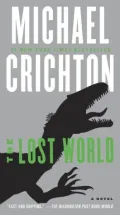
The Lost World by Michael Crichton — book cover

The Lost World

by Michael Crichton
Available on Bookshop Write a review

Books.org participates in affiliate programs including Bookshop.org and the Amazon Services LLC Associates Program. We may earn a commission from qualifying purchases made through links on this page, at no additional cost to you.

Log in to track your reading progress.

Overview

It is now six years since the secret disaster at Jurassic Park, six years since that extraordinary dream of science and imagination came to a crashing end - the dinosaurs destroyed, the park dismantled, the island indefinitely closed to the public. There are rumors that something has survived.

This extraordinary book pairs two major talents of our time, the painter/sculptor/printmaker Jasper Johns and the bestselling novelist/filmmaker/physician Michael Crichton. Long considered to be the preeminent study of one of America's foremost living artists, this edition is completely revised, expanded, and updated. 417 illustrations, including 103 in full color.

About the Author, Michael Crichton

Michael Crichton was born in Chicago and was graduated summa cum laude from Harvard University. At twenty-three, Crichton was a visiting lecturer in anthropology at Cambridge University, England. Upon his return to the States, Crichton began training as a doctor, and was graduated from Harvard Medical School in 1969. He paid his way through medical school by writing pseudonymous thrillers, one of which (A Case of Need, 1968) won an Edgar Award. By the time he graduated, Crichton had already written a bestseller (The Andromeda Strain, 1969) and sold it to Hollywood. He then pursued postgraduate studies at the Salk Institute in California before taking up writing full time.

Crichton has written ten novels — The Andromeda Strain, 1969; The Terminal Man, 1972; The Great Train Robbery, 1975; Eaters of the Dead, 1976; Congo, 1980; Sphere, 1987; Jurassic Park, 1990; Rising Sun, 1992; Disclosure, 1994; and The Lost World, 1995 — each of which displays an intimate knowledge of a different, specialist subject, among them primatology, neurobiology, biophysics, international economics, Nordic history and genetics. He has directed six movies, including Westworld, Coma, and The Great Train Robbery, and is the creator of the hit television series ER (which won eight emmys in 1995). He is a computer expert who wrote one of the first books about information technology (Electronic Life, 1983); he has run a software company; he has designed a computer game called Amazon; is a committed collector of modern art and the author of a learned study on Jasper Johns (Jasper Johns, 1977). His other works of nonfiction include Five Patients: The Hospital Explained, 1970, and Travels, 1988. Crichton's novels have been translated into twenty-four languages; eight of his novels have been made into films, including Jurassic Park, one of the most successful films in motion picture history.

Michael Crichton is married and lives in Los Angeles.

Biography

Michael Crichton's oeuvre is so vivid and varied that it hard to believe everything sprang from the mind of a single writer. There's the dino-movie franchise and merchandising behemoth Jurassic Park; the long-running, top-rated TV series ER, which Crichton created; and sci-fi tales so cinematic a few were filmed more than once. He's even had a dinosaur named after him.

Ironically, for someone who is credited with selling over 150 million books, Crichton initially avoided writing because he didn't think he would make a living at it. So he turned to medical school instead, graduating with an M.D. from Harvard in 1969. The budding doctor had already written one award-winning novel pseudonymically (1968's A Case of Need) to help pay the bills through school; but when The Andromeda Strain came out in the same year of his med school graduation, Crichton's new career path became obvious.

The Andromeda Strain brilliantly and convincingly sets out an American scientific crisis in the form of a deadly epidemic. Its tone -- both critical of and sympathetic toward the scientific community -- set a precedent for Crichton works to come. A 1970 nonfiction work, Five Patients offers the same tone in a very different form, that being an inside look at a hospital.

Crichton's works were inspired by a remarkably curious mind. His plots often explored scientific issues -- but not always. Some of his most compelling thrillers were set against the backdrop of global trade relations (Rising Sun), corporate treachery (Disclosure) and good old-fashioned Victorian-era theft (The Great Train Robbery). The author never shied away from challenging topics, but it's obvious from his phenomenal sales that he never waxed pedantic. Writing about Prey, Crichton's cautionary tale of nanotech gone awry, The New York Times Book Review put it this way: "You're entertained on one level and you learn something on another."

On the page, Crichton's storytelling was eerily nonfictional in style. His journalistic, almost professorial, and usually third-person narration lent an air of credibility to his often disturbing tales -- in The Andromeda Strain, he went so far as to provide a fake bibliography. Along the way, he revelled in flouting basic, often subconscious assumptions: Dinosaurs are long-gone; women are workplace victims, not predators; computers are, by and large, predictable machines.

The dazzling diversity of Crichton's interests and talents became ever more evident as the years progressed. In addition to penning bestselling novels, he wrote screenplays and a travel memoir, directed several movies, created Academy Award-winning movie production software, and testified before Congress about the science of global warming -- this last as a result of his controversial 2004 eco-thriller State of Fear, a novel that reflected Crichton's own skepticism about the true nature of climate change. His views on the subject were severely criticized by leading environmentalists.

On November 4, 2008, Michael Crichton died, following a long battle against cancer. Beloved by millions of readers, his techno-thrillers and science-inflected cautionary tales remain perennial bestsellers and have spawned a literary genre all its own.

Good To Know

Some interesting outtakes from our 2005 interview with Crichton:

"I'm very interested in 20th-century American art."

"I have always been interested in movies and television as well as books. I see all these as media for storytelling, and I don't discriminate among them. At some periods of my life I preferred to work on movies, and at others I preferred books."

"In the early 1990s, interviewers began calling me ‘the father of the techno-thriller.' Nobody ever had before. Finally I began asking the interviewers, ‘Why do you call me that?' They said, ‘Because Tom Clancy says you are the father of the techno-thriller.' So I called Tom up and said, ‘Listen, thank you, but I'm not the father of the techno-thriller.' He said, ‘Yes you are.' I said, ‘No, I'm not, before me there were thrillers like Failsafe and Seven Days in May and The Manchurian Candidate that were techno-thrillers.' He said, ‘No, those are all political. You're the father of the techno-thriller.' And there it ended."

"My favorite recreation is to hike in the wilderness. I am fond of Hawaii."

"I used to scuba dive a lot, but haven't lately. For a time I liked to photograph sharks but like anything else, the thrill wears off. Earlier in my life I took serious risks, but I stopped when I became a parent."

"I taught myself to cook by following Indian and Szechuan recipes. They each have about 20 ingredients. I used to grind my own spices, I was really into it. Now I don't have much time to cook anymore. When I do, I cook Italian food."

"I read almost exclusively nonfiction. Most times I am researching some topic, which may or may not lead to a book. So my reading is pretty focused, although the focus can shift quickly."

"I have always been interested in whatever is missing or excluded from conventional thought. As a result I am drawn to writers who are out of fashion, bypassed, irritating, difficult, or excessive. I also like the disreputable works of famous writers. Thus I end up reading and liking Paul Feyerabend (Against Method), G. K. Chesterton (Orthodoxy, What's Wrong with the World), John Stuart Mill, Hemingway (Garden of Eden), Nietzsche, Machiavelli, Alain Finkielkraut (Defeat of the Mind), Anton Ehrenzweig (Hidden Order of Art), Arthur Koestler (Midwife Toad, Beyond Reductionism), Ian McHarg (Design with Nature), Marguerite Duras, Jung, late James M. Cain (Serenade), Paul Campos.

"Because I get up so early to work, I tend to go to bed early, around 10 or 11. So I don't go out much. I suppose I am borderline reclusive. I don't care."

Reviews

There are no reviews yet. Log in to write one.

Editorials

Mim Udovitch

"The Lost World" is Mr. Crichton's sequel to the enormously successful "Jurassic Park"....The plot is slower to start this time around, but it can afford to be, since, the mask of inherent unpredictability notwithstanding, we know what's coming. It is, however, substantially similar, and since its pleasures are those of a thriller, for review purposes let that suffice. -- New York Times

Publishers Weekly - Publisher's Weekly

One fact about this sequel to Jurassic Park stands out above all: it follows a book that, with spinoffs, including the movie, proved to be the most profitable literary venture ever. So where does the author of a near billion-dollar novel sit? Squarely on the shoulders of his own past work-and Arthur Conan Doyle's. Crichton has borrowed from Conan Doyle before-Rising Sun was Holmes and Watson in Japan-but never so brazenly. The title itself here, the same as that of Conan Doyle's yarn about an equatorial plateau rife with dinos, acknowledges the debt. More enervating are Crichton's self-borrowings: the plot line of this novel reads like an outtake from JP. Instead of bringing his dinos to a city, for instance, Crichton keeps them in the Costa Rican jungle, on an offshore island that was the secret breeding ground for the beasts. Only chaos theoretician Ian Malcolm, among the earlier principals, returns to explore this Lost World, six years after the events of JP; but once again, there's a dynamic paleontologist, a pretty female scientist and two cute kids, boy and girl-the latter even saves the day through clever hacking, just as in JP. Despite stiff prose and brittle characters, Chrichton can still conjure unparalleled dino terror, although the wonder is gone and the attacks are predictable, the pacing perfunctory. But his heart now seems to be not so much in the storytelling as in pedagogy: from start to finish, the novel aims to illustrate Crichton's ideas about extinction-basically, that it occurs because of behavioral rather than environmental changes-and reads like a scientific fable, with pages of theory balancing the hectic action. As science writing, it's a lucid, provocative undertaking; but as an adventure and original entertainment, even though it will sell through the roof, it seems that Crichton has laid a big dinosaur egg. 2,000,000 first printing; BOMC and QPB main selection. (Sept.)

Library Journal

abridgment of Crichton's latest novel, a sequel of sorts to the best-selling Jurassic Park Knopf, 1990. Ian Malcolm, who supposedly died at the end of Jurassic Park, nonetheless returns to the islands off Costa Rica with a new crew to search for lost worlds of dinosaurs and investigate several theories of extinction. Unfortunately, The Lost World comes up short compared to the intrigue that the extraction, repair, and replication of dinosaur DNA generated for readers and listeners in Jurassic Park. Instead, The Lost World consists mostly of more dinosaurs that chase and sometimes capture Malcolm's cohorts or members of a rival gang led by an unscrupulous genetic engineer, Lew Dodgson. Dodgson would love to steal a few dinosaur eggs as part of a scheme to hatch the perfect laboratory animal "If they're extinct, then they can't have any rights," Dodgson observes. Recommended.-Cliff Glaviano, Bowling Green State Univ. Libs., Ohio

Ray Olson

Every Cretaceous critter in John Hammond's bioengineered dinosaur preserve was destroyed after the events of "Jurassic Park". Yet five years later, carcasses of recently dead, supposedly extinct saurians are washing ashore on nearby islands. Time for intrepid scientists to discover and observe again. Onboard this time are the chaos and complexity theorist who almost died in Hammond's folly, a stuck-up rich guy paleontologist, an Amazon of a large-animal ethologist, a regular-guy engineering genius and his assistant, and two computer whiz kids who stow away to join the adults. And, of course, there are venal villains (three) trying to get to the salable goods first (guess what their fate is). Crichton adroitly combines popular scientific colloquy and ripping good, blood-and-guts (literally) action once again. If it all seems rather predictable, remember that the pleasures of familiarity and referentiality rank high among the rewards of popular fiction. Here such pleasures begin with the title, plundered directly from the granddaddy of the modern-day dinosaur romance, Arthur Conan Doyle's "Lost World" (1912).

From Barnes & Noble

It's been six years since the secret disaster at Jurassic Park, when the extraordinary dream of science and imagination came to a crashing end. The dinosaurs are destroyed, the park is closed, but there are rumors that something has survived. The Jurassic Park sequel turned motion picture.

Book Details

Published
October 30, 2012
Publisher
Random House Publishing Group
Pages
432
Format
Mass Market Paperback
ISBN
9780345538994

More by Michael Crichton

Similar books