
Theory of Relativity, Theoretical Physics, Geometry - Differential, Electromagnetism - General & Miscellaneous, Physics of Time, Mathematics - Applied
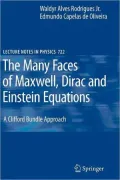
The Many Faces of Maxwell, Dirac and Einstein Equations: A Clifford Bundle Approach
Waldyr A. Rodrigues
Available on Bookshop
Write a review
Books.org participates in affiliate programs including Bookshop.org and the Amazon Services LLC Associates Program. We may earn a commission from qualifying purchases made through links on this page, at no additional cost to you.
Log in to track your reading progress.
Overview
This book is a comprehensive reference on differential geometry. It shows that Maxwell, Dirac and Einstein fields, which were originally considered objects of a very different mathematical nature, have representatives as objects of the same mathematical nature. The book also analyzes some foundational issues of relativistic field theories. All calculation procedures are illustrated by many exercises that are solved in detail.
Synopsis
Maxwell, Dirac and Einstein’s equations are certainly among the most imp- tant equations of XXth century Physics and it is our intention in this book to 1 investigate some of the many faces of these equations and their relationship and to discuss some foundational issues involving some of the theories where they appear. To do that, let us brie?y recall some facts. Maxwell equations which date back to the XIXth century encodes all cl- sical electromagnetism, i. e. they describe the electromagnetic ?elds generated by charge distributions in arbitrary motion. Of course, when Maxwell f- mulated his theory the arena where physical phenomena were supposed to occur was a Newtonian spacetime, a structure containing a manifold which is 3 di?eomorphic to R×R , the ?rst factor describing Newtonian absolute time 2 [25] and the second factor the Euclidean space of our immediate perception . In his original approach Maxwell presented his equations as a system of eight linear ?rstorderpartialdi?erentialequations involvingthe components of the electricandmagnetic?elds[17]generatedbychargeandcurrentsdistributions 3 with prescribed motions in vacuum . It was only after Heaviside [12], Hertz and Gibbs that those equations were presented using vector calculus, which by the way, is the form they appear until today in elementary textbooks on Electrodynamics and Engineering Sciences. In the vector calculus formalism Maxwell equations are encoded in four equations involving the well known divergentandrotationaloperators.Book Details
Published
November 24, 2010
Publisher
Springer-Verlag New York, LLC
Pages
460
Format
Paperback
ISBN
9783642090387