
Europe - Peoples & Places, Renaissance - History, Europe - General & Miscellaneous - History
Log in to track your reading progress.
Editorials
Children's Literature
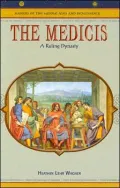
This book is part of the "Makers of the Middle Ages and Renaissance" series. It is divided into six chapters: "Murder in the Cathedral," "Bankers to the Republic," "Lorenzo the Magnificent," "A Medici Pope," "Catherine de Medici," and "A Dynasty's Decline." Wagner does not hide the family's troubled past, but rather she tells their story and all its gruesome details. Colorful reproductions of the artwork the family helped fund are reprinted on many of the pages, though there are a few photographs of important sites in Florence to which the family is linked. While the book opens with an intriguing action scene by describing the Pazzi Conspiracy, this book is probably not the most inspiring to young readers because of the grey cover and the nature of the artwork included. After each chapter there is a five question quiz entitled "Test Your Knowledge" that reviews major historical facts. Throughout the text there are a few lengthy sidebars that explain in-depth important topics, such as the Duomo, Michelangelo, and the papal electoral process. While there is a comprehensive chronology and timeline, there is no glossary of terms, nor is there a map of Italy or a family tree explaining how each member is related to help young readers gain a thorough understanding of this family's life. The library binding makes it a good acquisition for a school whose curriculum covers this time period. 2005, Chelsea House, Ages 9 to 12.—Elizabeth Sulock
School Library Journal
Gr 6-9-These books are good examples of bad biographies. They are superficial and poorly written, awkward and repetitious. Both lack maps, a major liability as dozens of places (many unfamiliar to modern readers) are crucial to the subjects' stories. Both also lack glossaries, a big deterrent as neither author does a particularly good job of defining terms in context. Family trees would also be beneficial to keep track of often convoluted relationships. Eleanor has glaring errors and omissions. For example, the author states on one page that Eleanor's first daughter was Marie, and on another, Margaret; Henry II did not inherit England from his father, as the book claims, but through his mother. Polly Shoyer Brooks's Queen Eleanor (Houghton, 1999) is a better choice. In just her first chapter in The Medicis, Wagner throws out the words mass, cathedral, pope, cardinal, archbishop, mercenary, villa, host (religious), sacrilege, priest, choir (architecture), altar, clergy, and organ gallery; she also frequently refers to the Renaissance without ever explaining what it is or why it is significant. Nothing else is available for this audience specifically on the Medici family.-Ann W. Moore, Schenectady County Public Library, NY Copyright 2006 Reed Business Information.Book Details
Published
September 1, 2005
Publisher
Facts on File, Incorporated
Pages
168
Format
Library Binding
ISBN
9780791086308