
Join Books.org — it's free

German Fiction, General & Miscellaneous Book Notes, Literary Styles & Movements - Fiction
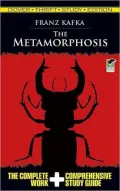
The Metamorphosis by Franz Kafka β€” book cover

The Metamorphosis

by Franz Kafka
Available on Bookshop Write a review

Books.org participates in affiliate programs including Bookshop.org and the Amazon Services LLC Associates Program. We may earn a commission from qualifying purchases made through links on this page, at no additional cost to you.

Log in to track your reading progress.

Overview

Includes the unabridged text of Kafka's classic novella plus a complete study guide that helps readers gain a thorough understanding of the work's content and context. The comprehensive guide includes chapter-by-chapter summaries, explanations and discussions of the plot, question-and-answer sections, author biography, analytical paper topics, list of characters, bibliography, and more. A selection of the Common Core State Standards Initiative.

Synopsis

A traveling salesman awakens from troubled slumbers to find himself transformed into a giant insect. Franz Kafka's matter-of-fact tone brings an air of absolute truth to his fantastic narrative, which chronicles the effects of this monstrous conversion upon the protagonist's business and family life. Interpretations of Kafka's acclaimed 1915 novella range from religious allegory to psychoanalytic case history. All agree upon its status as a landmark work of twentieth-century fiction. A definitive survey, this Dover Thrift Study Edition offers the novel's complete and unabridged text, plus a comprehensive study guide. Created to help readers gain a thorough understanding of the content and context of The Metamorphosis, the guide includes: β€’ Chapter-by-chapter summaries
β€’ Explanations and discussions of the plot
β€’ Question-and-answer sections
β€’ Kafka biography
β€’ List of characters and more
Dover Thrift Study Editions feature everything that students need to undertake a confident reading of a classic text, as well as to prepare themselves for class discussions, essays, and exams. A selection of the Common Core State Standards Initiative.

About the Author, Franz Kafka

Franz Kafka was born in 1833 to a well-to-do middle-class Jewish family. His father, the self-made proprietor of a wholesale haberdashery business, was a domineering man whose approbation Franz continually struggled to win. The younger Kafka's feelings of inadequacy and guilt form the background of much of his work and are made explicit in his "Letter to His Father" (excerpted in this volume), which was written in 1919 but never sent. Kafka was educated in the German language schools of Prague and at the city's German University, where in 1908 he took a law degree. Literature, however, remained his sole passion. At this time he became part of a literary circle that included Franz Werfel, Martin Buber, and Kafka's close friend Max Brod. Encouraged by Brod, Kafka published the prose collection Observations in 1913. Two years later his story "The Stoker" won the Fontaine prize. In 1916 he began work on The Trial and between this time and 1923 produced three incomplete novels as well as numerous sketches and stories. In his lifetime some of his short works did appear: The Judgment (1916), The Metamorphosis (1916), The Penal Colony (1919), and The Country Doctor (1919). Before his death of tuberculosis in 1924, Kafka had charged Max Brod with the execution of his estate, ordering Brod to burn the manuscripts. With the somewhat circular justification that Kafka must have known his friend could not obey such an order, Brod decided to publish Kafka's writings. To this act of "betrayal" the world owes the preservation of some of the most unforgettable and influential literary works of our century.

Biography

Franz Kafka was born in 1883 to a well-to-do middle-class Jewish family. His father, the self-made proprietor of a wholesale haberdashery business, was a domineering man whose approbation Franz continually struggled to win. The younger Kafka's feelings of inadequacy and guilt form the background of much of his work and are made explicit in his "Letter to His Father" (excerpted in this volume), which was written in 1919 but never sent.

Kafka was educated in the German language schools of Prague and at the city's German University, where in 1908 he took a law degree. Literature, however, remained his sole passion. At this time he became part of a literary circle that included Franz Werfel, Martin Buber, and Kafka's close friend Max Brod. Encouraged by Brod, Kafka published the prose collection Observations in 1913. Two years later his story "The Stoker" won the Fontaine prize. In 1916 he began work on The Trial and between this time and 1923 produced three incomplete novels as well as numerous sketches and stories. In his lifetime some of his short works did appear: The Judgment (1916), The Metamorphosis (1916), The Penal Colony (1919), and The Country Doctor (1919).

Before his death of tuberculosis in 1924, Kafka had charged Max Brod with the execution of his estate, ordering Brod to burn the manuscripts. With the somewhat circular justification that Kafka must have known his friend could not obey such an order, Brod decided to publish Kafka's writings. To this act of "betrayal" the world owes the preservation of some of the most unforgettable and influential literary works of our century.

Biography courtesy of BN.com

Reviews

There are no reviews yet. Log in to write one.

Editorials

Jewish Book World

The only stories published in Kafka's lifetime, this collection contains the best-known novellas and stories from one of the seminal writers of the 20th century. Each work is unique and spellbinding. You don't know what's going to happen and you can't put it down.

Piscator in Massachusetts

This presentation of the classic Kafka tale is a treasure trove. Jens Kruse's excellent introductory essay, and detailed, informative notes and photos greatly enhance our sense of Samsa's predicament and Kafka's techniques. This is my first eNotated text and I found the text and annotations very easy to navigate. If this edition is any indication, the e-notated series of literary classics will be a great success -- an ideal choice for serious readers. A winner all the way.

Book Details

Published
August 3, 2009
Publisher
Dover Publications
Pages
120
Format
Paperback
ISBN
9780486475714

More by Franz Kafka

Similar books