
20th Century American History - Economic Aspects - Post World War II, Monetary Policy, Economic Policies in the United States, United States - Economic History, Governmental Finances & Fiscal Policies, Finance - Debt
Available on Bookshop
Write a review
Books.org participates in affiliate programs including Bookshop.org and the Amazon Services LLC Associates Program. We may earn a commission from qualifying purchases made through links on this page, at no additional cost to you.
Log in to track your reading progress.
Overview
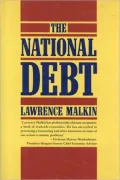
What, exactly, is the National Debt--and to whom do we owe the money--two trillion dollars worth? That's a pile of one thousand dollar bills 134 miles high, and climbing. Just paying the interest costs is equivalent to the entire federal income tax collected west of the Mississippi. How did we get into such a fix? This book explains why the government, politicians of both parties, and all the rest of us have delayed putting our house in order; how Reaganomics delivered something very different from what it promised; how one devoted but nevertheless unelected public servant, Chairman Paul Volcker of the Federal Reserve Board, has been left to mind the store; how we turned into a net debtor to the rest of the world; how our economic destiny is increasingly determined by foreigners, and how the world's financial system could shiver around us as a result. What are the constraints this unimaginable debt imposes on our society, what is the threat it poses to our political stability, and what does it mean to the individual American--not to mention almost everyone else in the world? Debt is a dilemma that will not go away, despite Washington's attempts to persuade us otherwise. At some point something may snap, and this book suggests when that breaking point might come. Lawrence Malkin, one of our most respected economics journalists, has written an eloquent, witty, fact-filled, and provocative treatise on what is becoming the great dilemma of this decade.
Editorials
Publishers Weekly -
Defining economics as ``politics with a few numbers to illuminate its ideas,'' Time economic correspondent Malkin explores in accessible, often humorous terms the reasons for the change in status, after World War II, of the U.S. from world-economy master to world creditor. Misguided politicians and economists, he charges, largely are responsible for the staggering and unprecedented national debtgovernment and personalincluding a huge debt interest, much of it owed to foreign investors, that threatens not only our own economy, trade balance and social fabric but the world's financial systems as well. He credits our former prosperity to combined government and private initiatives, and traces present conditions to the Keynesian deficit financing of the Great Society and Vietnam War during the Johnson and Nixon years, now magnified by Reagan's tax cuts, military buildup and unbridled credit-based consumerism. Comparing today's conditions with those of the 192629 boom, Malkin suggests that common sense and cooperation between public and private sectors and between nations may avoid a similar catastrophe in the future. (April 30)Library Journal
The title is somewhat misleading as this volume paints a panorama of all types of debt: U.S. national debt, consumer and business debt, Third World debt, and U.S. foreign debt. Anecdotes and history rather than economic analysis sustain the narrative. Although Malkin, an economics correspondent for Time , tells some interesting stories, there is no great depth to the discussion, nor are there many recommendations for dealing with the ``swamp of debt.'' All the reader is left with is the impression that too much debt is bad. Recommended primarily for public libraries that need a very basic introduction to the problem. Richard C. Schiming, Economics Dept., Mankato State Univ., Minn.Book Details
Published
April 1, 1987
Publisher
Holt, Henry & Company, Inc.
Pages
309
ISBN
9781466815469