
Microeconomics, Personal Finance - General & Miscellaneous, Medical Practice Management & Reimbursement
Log in to track your reading progress.
Overview
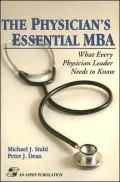
The Physician's Essential MBA: What Every Physician Leader Needs to Know is the essential resource for physicians who are seeking sophisticated business and managerial skills in order to survive in today's health care environment. This comprehensive text covers everything from change and strategy to effective data utilization.
The book contains black-and-white illustrations.
Editorials
From The Critics
Reviewer: Anna Maio, MD(Creighton University Medical Center)Description: The editors of this book bring together numerous contributors to review changes in the healthcare industry and physician's strategies to contribute to the process. They also deal with promoting financial stability in the marketplace, leadership, and information technology.
Purpose: The editors state that they want to assist physicians in making a decision about whether or not to get an MBA, to give physicians an overview of what receiving an MBA would involve, and also to help their families understand what a physician would learn.
Audience: The book is written primarily for physicians who are involved in administrative jobs and in the business of medicine and want to become better prepared for the present and the future. The two editors and numerous contributors are all credible authorities on this subject matter and offer their insight into whether or not a physician should get an MBA and what the content of that training should include.
Features: The book is divided into four major sections with approximately four chapters m each section. These sections include: change in the healthcare industry; financial stability and business practice; leadership skills — including business ethics; and information and technology — including continuous quality improvement. The best features of the book are stand alone chapters with well-detailed tables of contents, simple text supplemented with good graphs and charts, a glossary of terms, and a reference section which is up-to-date.
Assessment: Upon reading this book physicians will grasp a sense of whether or not they would be interested in an MBA degree and what the course content would be on some basic level. This book should be recommended to any physician seriously considering obtaining an MBA.
From The Critics
Reviewer: Anna Maio, MD(Creighton University Medical Center)Description: The editors of this book bring together numerous contributors to review changes in the healthcare industry and physician's strategies to contribute to the process. They also deal with promoting financial stability in the marketplace, leadership, and information technology.
Purpose: The editors state that they want to assist physicians in making a decision about whether or not to get an MBA, to give physicians an overview of what receiving an MBA would involve, and also to help their families understand what a physician would learn.
Audience: The book is written primarily for physicians who are involved in administrative jobs and in the business of medicine and want to become better prepared for the present and the future. The two editors and numerous contributors are all credible authorities on this subject matter and offer their insight into whether or not a physician should get an MBA and what the content of that training should include.
Features: The book is divided into four major sections with approximately four chapters m each section. These sections include: change in the healthcare industry; financial stability and business practice; leadership skills — including business ethics; and information and technology — including continuous quality improvement. The best features of the book are stand alone chapters with well-detailed tables of contents, simple text supplemented with good graphs and charts, a glossary of terms, and a reference section which is up-to-date.
Assessment: Upon reading this book physicians will grasp a sense of whether or not they would be interested in an MBA degree and what the course content would be on some basic level. This book should be recommended to any physician seriously considering obtaining an MBA.
Anna Maio
The editors of this book bring together numerous contributors to review changes in the healthcare industry and physician's strategies to contribute to the process. They also deal with promoting financial stability in the marketplace, leadership, and information technology. The editors state that they want to assist physicians in making a decision about whether or not to get an MBA, to give physicians an overview of what receiving an MBA would involve, and also to help their families understand what a physician would learn. The book is written primarily for physicians who are involved in administrative jobs and in the business of medicine and want to become better prepared for the present and the future. The two editors and numerous contributors are all credible authorities on this subject matter and offer their insight into whether or not a physician should get an MBA and what the content of that training should include. The book is divided into four major sections with approximately four chapters m each section. These sections include: change in the healthcare industry; financial stability and business practice; leadership skills -- including business ethics; and information and technology -- including continuous quality improvement. The best features of the book are stand alone chapters with well-detailed tables of contents, simple text supplemented with good graphs and charts, a glossary of terms, and a reference section which is up-to-date. Upon reading this book physicians will grasp a sense of whether or not they would be interested in an MBA degree and what the course content would be on some basic level. This book should be recommended to any physician seriously consideringobtaining an MBA.Booknews
Managed health care has physicians juggling their white coats and business suits. In 16 chapters (each with a glossary) devoted to bridging this cultural and skills gap, management types, organizational psychologists, and a lone M.D. scope the areas of economics and strategy in the mutating health care industry; business processes/systems for financial stability; leadership styles; and turning data into information-using technology. Annotation c. Book News, Inc., Portland, OR (booknews.com)3 Stars from Doody
Book Details
Published
March 1, 1999
Publisher
Gaithersburg, Md. : Aspen Publishers, 1999.
Pages
322
Format
Paperback
ISBN
9780834212442