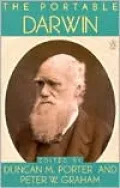
Charles Darwin
Scientist Charles Darwin once asserted that "a scientific man ought to have no wishes, no affections -- a mere heart of stone." Indeed, his objective take on evolution asserted in The Origin of Species shook the foundations of traditional religion to its core.
Biography
Robert Charles Darwin was born in Shrewsbury, England, on February 12, 1809, into a wealthy and highly respected family. His grandfather, Erasmus Darwin, was a doctor and the author of many works, including his well-known Zoonomia, or the Laws of Organic Life, which suggested a theory of evolution. Charles's father, Robert Waring Darwin, was also a prosperous doctor; his mother, Susannah, was the daughter of Josiah Wedgwood, founder of the renowned Wedgwood potteries. The Darwins and the Wedgwoods had close and long-standing relations, and Charles was to marry his cousin, Emma Wedgwood. In 1825 at age sixteen, Darwin matriculated at Edinburgh University to study medicine. There, his early interest in natural history developed, and he studied particularly crustaceans, sea creatures, and beetles. Nauseated by the sight of blood, however, he decided that medicine was not his vocation, left Edinburgh in 1827 and entered Christ's College, Cambridge University, with no clear sense of possible vocation, theology itself being an option. At Cambridge he became friends with J. S. Henslow, a clergyman who was also professor of botany. Although Darwin was to graduate from Cambridge with a B.A. in theology, he spent much time with Henslow, developing his interest in natural science. It was Henslow who secured a position for Darwin on an exploratory expedition aboard the HMS Beagle.
In December 1831, the year he graduated from Cambridge, Darwin embarked upon a five-year voyage to Africa and South America, acting as a companion to the captain, Robert Fitzroy. Darwin spent more time in land expeditions than at sea, where he was always seasick, but during the long voyages he continued his collecting and, cramped in his tiny cabin, meticulously wrote up his ideas. Several years after his return, at the time of the birth of his first son, William, Darwin fell ill. It is conjectured that while in South America he had contracted Chagas's disease, but whatever the cause, the effects were debilitating for the rest of Darwin's life.
By the time he returned to London in 1835, many of his letters, some to scientists like Charles Lyell and Adam Sedgwick, had been read before scientific societies, and he was already a well known and respected naturalist. His first published book, an account of his voyage aboard the Beagle, entitled Journal of Researches, appeared in 1839 and was widely popular. He married the same year; soon after, the family moved from London to a secluded house at Down, in Kent, where Darwin wrote initial sketches of his theory and then preparing himself for the full exposition, spent eight years writing a detailed set of definitive monographs on barnacles.
In 1858, when Darwin was halfway through writing his book, "Natural Selection," A. R. Wallace sent him a paper called, "On the Tendency of Varieties to Depart Indefinitely from the Original Type." In language similar to Darwin's own, Wallace laid out the argument for natural selection. Wallace asked Darwin to help get the paper published -- obviously an alarming development for a man who had given twenty years of his life to getting the argument for natural selection right. Darwin's scientific friends advised him to gather materials giving evidence of his priority but to have the Wallace paper read before the Linnaean Society, along with a brief account of his own ideas. Immediately after the reading, Darwin began work on his "abstract" of "Natural Selection." The result was On the Origin of Species by Means of Natural Selection, published in 1859. Despite the controversy it generated, it was an immense success and went through five more editions in Darwin's lifetime.
Darwin devoted the rest of his life to researching and writing scientific treatises, drawing on his notebooks and corresponding with scientists all over the world, and thus developing and modifying parts of his larger argument.
Darwin never traveled again and much of his scientific work was done in his own garden and study at home. Others, particularly his "bulldog," T. H. Huxley, fought the battle for evolution publicly, and as Darwin remained quietly ailing at home, his family grew -- he had ten children -- and so did his reputation. Although he was always ill with symptoms that made it impossible for him to work full days, he produced an enormous volume of work. His death, on April 19, 1882, was a national event. Despite the piety of his wife, Emma, Darwin had fallen away from religion as he reflected both on the way nature worked and on the way his favorite daughter, Annie, died painfully from an unknown feverish illness, when she was ten. Nevertheless, ironically, he was buried in Westminster Abbey.
Author biography from the Barnes & Noble Classics edition of The Origin of Species.
Good To Know
Darwin was born on the same day as U.S. president Abraham Lincoln. He broke his longtime snuff habit by keeping his snuff box in the basement and the key to it in the attic.