
Britain - Historical Biography - General & Miscellaneous, Medieval Military History, Geography - General & Miscellaneous, Medieval English Literature - Literary Criticism, British Authors - General & Miscellaneous - Literary Biography, General & Miscellan
Log in to track your reading progress.
Overview
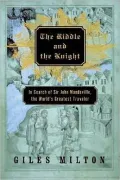
Part travelogue/part historical mystery about the most famous traveler--and chronicler-- in medieval Europe.Giles Milton's first book, The Riddle and the Knight, is a fascinating account of the legend of Sir John Mandeville, a long-forgotten knight who was once the most famous writer in medieval Europe. Mandeville wrote a book about his voyage around the world that became a beacon that lit the way for the great expeditions of the Renaissance, and his exploits and adventures provided inspiration for writers such as Shakespeare, Milton, and Keats. By the nineteenth century however, his claims were largely discredited by academics. Giles Milton set off in the footsteps of Mandeville, in order to test his amazing claims, and to restore Mandeville to his rightful place in the literature of exploration.
"Erudite, witty and adventurous" (The Mail on Sunday), The Riddle and the Knight is a brilliant piece of detective work.
Editorials
John Julius Norwich
. . . Here . . . is a book which, while always readable and amusing, takes Sir John Mandeville as seriously as he deserves.Publishers Weekly
Milton (Big Chief Elizabeth) exhumes The Travels, Mandeville's notorious account of leaving for the Holy Land in 1322 only to return 34 years later with wild tales of pygmies, giants and gem-bearing plants not to mention the first account of man's ability to circumnavigate the globe. Mandeville's account offered thrilling information, but unfortunately none of it was true: whole sections of The Travels were lifted from the pages of his peers, and he never met the denizens of Sumatra or China as he claimed. The resulting scandal left his reputation sullied and his work discredited. Six hundred years later, Milton takes up Mandeville's torch to present a remarkable narrative that follows closely in his predecessor's footsteps and knits together a contemporary travelogue with an investigation of the Mandeville myth. Visiting churches from Istanbul to Sinai, Milton tracks Mandeville's passage from West to East, revealing what there is to be known about the history of the explorer and his fanciful book, which had inspired everyone from Mercator to Columbus. The strange and wonderful characters who appear throughout the Muslim gatekeeper at the alleged tomb of Christ or the multilingual friend who compulsively watches national television stations sign off are like modern-day reflections of the people Mandeville described with such fascination and hyperbole. A rare and excellent work that combines scholarship with intrigue, Milton's book may induce that wonderful swoon usually contracted after long hours researching libraries and labyrinths of history. Illus. (Nov.) Copyright 2001 Cahners Business Information.Booknews
According to his own account<-->the most widely read travelogue in the Middle Ages<-->Mandeville left England for the Holy Land in 1322 and returned in 1356 having meanwhile stopped by India, China, Tibet, Java, and Sumatra. Milton looks for the person who made such outlandish claims, noting that his view of the world was very different from most of his contemporaries. Annotation c. Book News, Inc., Portland, OR (booknews.com)Kirkus Reviews
Originally published in Britain in 1996, this trek in the footsteps of a medieval Englishman created the template for Milton's later studies of historic journeys (Nathaniel's Nutmeg, 1999; Big Chief Elizabeth, 2000). Milton has invented a unique form of travel-writing, investigating the world as it existed in the yearnings and imagination of long-ago Europeans. Here, he sets out in search of Sir John Mandeville, a native of St. Albans who claimed to have traveled through the Holy Land to China, and whose Travels became one of the best-known books of the 14th century. Despite his influence on explorers from Columbus to Drake, Mandeville was all but written off by the Victorians. His vivid descriptions of the monstrosities of the East didn't jibe with 19th-century sensibilities, and the general conclusion was that the old man probably never left England at all. Milton attempts to rescue his protagonist from obscurity by visiting the places Mandeville claimed to have visited, hoping to find indications of veracity. He does this with considerable charm and some degree of success, gleaning tidbits about 14th-century Constantinople, Cyprus, Syria, and Jerusalem during his stays that seem to confirm Mandeville's account. He does not, however, attempt to trace Mandeville's alleged path into China and Indonesia; instead, he concludes, correctly but half-heartedly, that Mandeville never made it any farther East, and that the second half of Travels, with its accounts of giant snails and people with two heads, was part of a complicated allegory about the decline of Christendom that stands in purposeful contrast to the first. Milton does some impressive sleuthing along the way, tracking down all theMandevilles in England to find his man, but his historical analysis can be questionable (e.g., his discussion of the Nestorians). The story never quite rises to the level of the author's ingenuity and wit, as it would in Milton's subsequent books. A diverting if slightly underdone effort.Book Details
Published
October 1, 2001
Publisher
New York : Farrar, Straus, and Giroux, 2001.
Pages
240
Format
Hardcover
ISBN
9780374249977