
Children - Fiction & Literature, Children - Fairy Tales, Myths & Fables
Log in to track your reading progress.
Overview
Three forest trees dream of what they will one day become. One dreams of becoming a royal throne; one of being a ship that can withstand any storm; and one longs to stay in the forest and grow as tall as tall can be.Editorials
Publishers Weekly
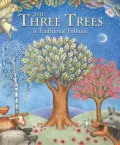
Using time-honored narrative conventions, Pasquali (Go Hare and Tortoise Go!) subtly renders the Christian Nativity and Easter stories to powerful effect. Three trees on a hill each dream of greatness: to be made into a treasure chest, a proud ship, and to point to heaven. Their initial hopes dashed by the humble uses made of their wood (a trough, a fishing-boat, and a cross), they come to realize their essential roles in the life of a great though unnamed king. Wide-eyed, curious animals (cats, chickens, sheep) and statuesque, pale angels bear witness to the unfolding drama in Windham’s (Unicorns! Unicorns!) earth-toned illustrations, while raindrops, falling leaves, drooping straw, swirling waves, and lightning convey energy and movement to counteract the stillness of the wooden main characters. Familiar biblical images such as the manger scene, Jesus calming the storm, and the crucifixion take on new resonance when narrated from the trees’ perspectives: “And the second tree knew that it was carrying the mightiest king the world had ever known.” A somber and evocative rendition of the gospel story. Ages 5–7. (Nov.)School Library Journal
Gr 1–3—Three saplings share their future dreams. One desires riches; the second, power; and the third simply wants to grow and point toward heaven. When all of them are cut down, the first two trees bemoan their humble fates as a trough and fishing boat. However, the one that became the trough finds itself holding a newborn baby and, "Knew that it was holding the greatest treasure the world had ever known." The tree that became a fishing boat is witness to a man calming the sea and knew it carried the mightiest king. The third tree becomes the cross upon which a man dies. It despairs until the man is resurrected, and it realizes that it will forever be a symbol of the man's life. It is obvious to adults that this is a Christian story, but the message is never explicitly stated. There is no author's note explaining its origin or cultural provenance. Although this retelling is gorgeously illustrated, libraries would do better to acquire Angela Elwell Hunt's version, The Tale of Three Trees (Chariot Victor, 1999), which has a clear, accessible message for young children.—Anna Haase Krueger, Antigo Public Library, WIBook Details
Published
January 21, 2011
Publisher
Lion Hudson
Format
Paperback
ISBN
9780745967202