
September 11th Terrorist Attacks, 2001, 20th Century American History - Relations - General & Miscellaneous, United States Studies - General & Miscellaneous, New York City - History, U.S. Diplomatic Relations - General & Miscellaneous, U.S. Politics & Gov
Log in to track your reading progress.
Overview
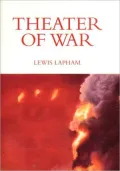
Nothing will be the same after September 11th. This is the wisdom, offered and widely received since the announcement of the war on terrorism: a permanent war declared on both an unknown enemy and an abstract noun. But in Theater of War, Lewis Lapham shows with customary intelligence and wit that the recent imperial behavior of the United States government is perfectly consistent with the practice of past administrations. Finding skeptics in the battle against evil has been a rare achievement. For example, as Lapham points out: "Ted Koppel struck the preferred note of caution on November 2 when introducing the Nightline audience to critics of the American bombing of Afghanistan: 'Some of you, many of you, are not going to like what you hear tonight. You don't have to listen.'" Unpopular opinions seldom make an appearance on the network news, and during the months since the destruction of the World Trade Center, the voices of dissent have been few and far between. Lewis Lapham is an exception. Almost alone among mainstream political commentators, he has had the courage to question the motive and feasibility, as well as the imperial pretension, of the Bush administration's infinite crusade against the world's evildoers.Editorials
From The Critics
At the party's 2000 convention, the Republican National Committee's finance chairman explained to a group of complaining midrange donors, "You pay a little more, you get a little more." For Harper's editor Lapham, this phrase stands as a nutshell definition of American politics. In his latest attack against American plutocracy, the author compares the country to imperial Rome in its decline, arguing that the "lopsided division of the country" into "the hapless many and the privileged few" has generated a kind of national low self-esteem visible in our neglected infrastructure and empty political discourse. "The view from the box seats holds that the embarrassments of death and failure will fall to the lot of persons to whom one has never been properly introduced," the author writes. Against this attitude—which arguably made September 11 inevitable—Lapham exhorts us, with characteristic eloquence, to re-create a democracy worth fighting for. Author—Eric WargoEric Wargo
At the party's 2000 convention, the Republican National Committee's finance chairman explained to a group of complaining midrange donors, "You pay a little more, you get a little more." For Harper's editor Lapham, this phrase stands as a nutshell definition of American politics. In his latest attack against American plutocracy, the author compares the country to imperial Rome in its decline, arguing that the "lopsided division of the country" into "the hapless many and the privileged few" has generated a kind of national low self-esteem visible in our neglected infrastructure and empty political discourse. "The view from the box seats holds that the embarrassments of death and failure will fall to the lot of persons to whom one has never been properly introduced," the author writes. Against this attitude—which arguably made September 11 inevitable—Lapham exhorts us, with characteristic eloquence, to re-create a democracy worth fighting for.Publishers Weekly
Harper's magazine editor Lapham (Money and Class in America) comes out doing the sarcastic equivalent of swinging in this collection of diatribes against incompetent hypocrisy in the media and government: "Maybe it's a trick of memory or a sign of age, but when I watch President George W. Bush threaten a White House television camera with a promise to punish the world's evildoers, the call to arms sounds like the sale pitch for an off-road vehicle or a lite beer," he writes in one of 14 jeremiads, published in his Harper's "Notebook" column between October 2000 and March 2002. Unfortunately, just as the above quote provides a double dose of self-doubt at the beginning and nowhere near enough wallop at the finish, most of these pieces, including an introductory tour of the last 50 years of U.S. foreign policy and small wars, lack laser-guided punch. At his best, however, Lapham summarizes and asserts his version of fin de siecle politics. Some of his post-September 11 remarks hit home, e.g., when he cites Alfred North Whitehead in arguing that the business of the future is to be dangerous. He wisely observes that "all societies, like most individuals, are always in some kind of trouble" and acutely concludes that it isn't trouble that kills, but rather "the fear of thought and the paralysis that accompanies the wish to believe that only the wicked perish." But such moments are difficult to pick out of the often diffuse text, and while criticism of the president has been somewhat muted, readers sympathetic to Lapham's point of view will wish he had gone even further out on a rhetorical limb. (Sept. 30) Copyright 2002 Cahners Business Information.Book Details
Published
January 9, 2002
Publisher
New York : New Press : 2002.
Pages
288
Format
Hardcover
ISBN
9781565847729