
United States History - 20th Century - General & Miscellaneous, Military Policy, Middle Eastern History, Iraqi Politics, U.S. International Relations, Middle Eastern Politics
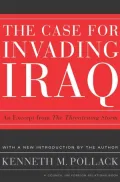
Available on Bookshop
Write a review
Books.org participates in affiliate programs including Bookshop.org and the Amazon Services LLC Associates Program. We may earn a commission from qualifying purchases made through links on this page, at no additional cost to you.
Log in to track your reading progress.
Overview
In The Threatening Storm, Kenneth M. Pollack, one of the world’s leading experts on Iraq, provides a masterly insider’s perspective on the crucial issues facing the United States as it moves toward a new confrontation with Saddam Hussein.For the past fifteen years, as an analyst on Iraq for the Central Intelligence Agency and the National Security Council, Kenneth Pollack has studied Saddam as closely as anyone else in the United States. In 1990, he was one of only three CIA analysts to predict the Iraqi invasion of Kuwait. As the principal author of the CIA’s history of Iraqi military strategy and operations during the Gulf War, Pollack gained rare insight into the methods and workings of what he believes to be the most brutal regime since Stalinist Russia.
Examining all sides of the debate and bringing a keen eye to the military and geopolitical forces at work, Pollack ultimately comes to this controversial conclusion: through our own mistakes, the perfidy of others, and Saddam’s cunning, the United States is left with few good policy options regarding Iraq. Increasingly, the option that makes the most sense is for the United States to launch a full-scale invasion, eradicate Saddam’s weapons of mass destruction, and rebuild Iraq as a prosperous and stable society—for the good of the United States, the Iraqi people, and the entire region.
Pollack believed for many years that the United States could prevent Saddam from threatening the stability of the Persian Gulf and the world through containment—a combination of sanctions and limited military operations. Here, Pollack explains why containment is no longer effective, and why other policies intended to deter Saddam ultimately pose a greater risk than confronting him now, before he gains possession of nuclear weapons and returns to his stated goal of dominating the Gulf region. “It is often said that war should be employed only in the last resort,” Pollack writes. “I reluctantly believe that in the case of the threat from Iraq, we have come to the last resort.”
Offering a view of the region that has the authority and force of an intelligence report, Pollack outlines what the leaders of neighboring Arab countries are thinking, what is necessary to gain their support for an invasion, how a successful U.S. operation would be mounted, what the likely costs would be, and how Saddam might react. He examines the state of Iraq today—its economy, its armed forces, its political system, the status of its weapons of mass destruction as best we understand them, and the terrifying security apparatus that keeps Saddam in power. Pollack also analyzes the last twenty years of relations between the United States and Iraq to explain how the two countries reached the unhappy standoff that currently prevails.
Commanding in its insights and full of detailed information about how leaders on both sides will make their decisions, The Threatening Storm is an essential guide to understanding what may be the crucial foreign policy challenge of our time.
From the Hardcover edition.
An eBook exclusive!
Editorials
From Barnes & Noble
Kenneth Pollack was a key CIA analyst on Iraq for seven years and personally wrote the agency's history of Iraqi military strategy and operations during the Gulf War. Subsequently, he served for three years on the National Security Council as the director for Gulf affairs, the principal working-level official responsible for implementation of U.S. policy toward Iraq. Richly detailed and calmly persuasive, The Threatening Storm discusses regional issues, Iraq's military capabilities, and other factors relevant to the challenges facing U.S. policy makers. Required reading for citizens who want to know.Foreign Affairs
The instant book has a bad name, and no doubt some critics will view this work — written before a war, not in its immediate aftermath — with grave suspicion. It is nonetheless exceptionally thoughtful. If any book can shape the current thinking on Iraq, this one will assuredly be it. The author made his reputation as a young CIA analyst who predicted Iraq's invasion of Kuwait in 1990. He has since worked in think tanks and on the National Security Council and has long been a prominent voice in this debate. He walks his reader through a brief history of the Ba'athist Iraqi state, the Gulf War, and the tortured history of Iraq's relations with the world since 1991. He examines the options for dealing with Saddam Hussein and boils them down to two: deterrence or invasion. The former, he argues, is the riskier course, because the Iraqi dictator has consistently flouted the rules of rational calculation beloved by political scientists. Pollack is sober about the dangers, costs, and implications of invasion but ends by concluding that it is the best option. This well-written work will no doubt attract much controversy. But it will be indispensable, even for those who disagree with its conclusions.Book Details
Published
March 25, 2003
Publisher
Random House Publishing Group
Pages
528
ISBN
9781588363411