
African American Politics & Government - Biography, United States - Civil Rights Movement - History, Political Figures - Biography, Law, Biography - General & Miscellaneous, African American Civil Rights Leaders - Biography
Log in to track your reading progress.
Synopsis
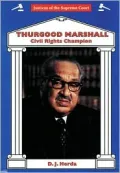
Describes both the professional and personal life of the first African-American Supreme Court Justice who gained notoriety as a defender of civil rights and social justiceEditorials
Children's Literature -
As part of a series on justices of the Supreme Court, this book's strength lies in the cases Marshall handled in his pursuit of civil rights; it gives the reader a good overview of his professional accomplishments and the racism he fought. In particular, the book offers a thorough discussion of the landmark Brown v. Board of Education, Topeka, Kansas. The presentation presumes that the students have a certain knowledge of court procedures. Of the book's 100 pages, only four deal with his youth, and another one with his undergraduate years. Although some interesting anecdotes are told about Marshall and his parents, the book may have been more fascinating if it allowed readers a deeper look at Thurgood's early life. For instance, the book's first sentence states that young Thurgood knew what it meant to be poor, but nowhere does it describe the conditions of that poverty, other than to say his father worked at an all-white country club and his mother was a teacher who got paid half the wages of white teachers. In many ways, the presentation of personal aspects of Thurgood's life is cursory at best.Book Details
Published
September 1, 1995
Publisher
Enslow Publishers
Pages
112
Format
Binding
ISBN
9780894905575