
United States History - Social Aspects, Women's History - 20th Century, 20th Century American History - General & Miscellaneous, Feminism - History, Women's History - U.S. - General & Miscellaneous
Log in to track your reading progress.
Overview
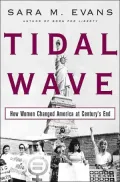
As recently as 1960 few women worked outside the home, married women could not borrow money in their own names, schools imposed strict quotas on female applicants, and sexual harassment did not exist as a legal concept. In Tidal Wave, Sara M. Evans, one of our foremost historians of women in America, draws on an extraordinary range of interviews, archives, and published sources to tell for the first time the incredible story of the past forty years in women's history.Encompassing the so-called Second Wave of feminism (1960s and 1970s) and the Third Wave (1980s and 1990s), Evans challenges traditional interpretations of women's history at every turn. Covering politics, economics, popular culture, marriage, and family, and including the perspectives of women ranging from leaders of NOW to little-known women who simply wanted more out of their lives, Tidal Wave paints a vast canvas of a society in upheaval. The movement's shocking success is evinced, Evans notes, by the simple fact that we now live in a country in which all women are feminists, in practice if not in name.
Editorials
The Los Angeles Times
Historian Sara Evans took on this daunting challenge and gives us a history that is readable and insightful, lively and judicious, strongly argued and open-minded, enthusiastic and critical. — Linda GordonThe Washington Post
Evans's most striking revelations are about the animated interchanges among different political camps of women. She does an excellent job of integrating, for the first time, the stories of black and white activists, dispelling the tired stereotype of feminism as a white women's movement. Although she doesn't make the point explicitly, her narrative shows how productively blacks and whites, radicals and liberals, local protesters and Washington insiders worked with one another. The collaborations were often inadvertent and loaded with suspicion -- black women always distanced themselves from the rubric of "feminism," for example, while liberal members of NOW always took care to distinguish themselves from the hell-raisers in "women's lib." But her depictions of a broad spectrum of activity in the 1970s and '80s — countercultural music festivals, Emily's List, campaigns against forced sterilization, feminist-inspired labor organizing — vivify, as no generalizations could, the extraordinary creative reach of the movement. — Christine StansellPublishers Weekly
Evans, who has taught women's history at the University of Minnesota since 1976 and written several books on feminism, including Born for Liberty and Personal Politics, has attempted here the nearly impossible: to write a nonpartisan, totally inclusive account of modern (i.e., 1960-2002) feminism in America. A movement with slogans like "the personal is political"; which demanded, at times, self-criticism and anti-elitist nonleaders; and generally rejected party-line politics is necessarily a difficult one to document, much less to summarize. But Evans is determined to write down as much of this history as possible, "to affirm for future generations that they do indeed have a history, by turns glorious and distressing, on which they can build." She sees feminism as a rising tide in the late 1960s and '70s, engendering an undertow pulling women back in the '80s, resulting in a resurgence of women in the '90s. Evans views the women's movement as a "tidal wave" destined to prevail (even if the steady in-and-out of tides might also suggest the power of the status quo). She lays out her chapters chronologically, with a wealth of detail on people, ideas, organizations and acronyms, all carefully identified. Personal accounts of the movement, like Roxanne Dunbar-Ortiz's Outlaw Woman, are more engaging than this condensed, encyclopedic overview; still, it will be a useful textbook for women's studies classes. (Mar. 3) Copyright 2002 Cahners Business Information.Library Journal
The Distinguished McKnight University Professor of History at the University of Minnesota, Evans continues exploring the history of second-wave feminism, begun with Personal Politics: The Roots of Women's Liberation in the Civil Rights Movement and the New Left. Again viewing events as a participant and a historical observer, Evans argues that the intensity associated with the feminist epiphany that the personal is political led to both great energy and great change but also to painful implosions within the women's movement over personal and philosophical differences. Like other movement memoirists, Evans emphasizes the desire of feminists to include women of all races and economic backgrounds, although a unified movement remained elusive. But, she contends, the proliferation of movement groups also provided space to women with extraordinarily diverse agendas. Ending on a positive note, she points out a resurgence sparked by renewed concern about sexual harassment, the threat to abortion rights, and the globalization of women's issues. Evans's accessible style makes this work suitable for most academic and large public libraries.-Cynthia Harrison, George Washington Univ., Washington, DC Copyright 2003 Reed Business Information.Kirkus Reviews
Has feminism been a failure, as some of its critics have charged? Did it die in the 1980s? Certainly not, writes historian Evans in this fine overview of its many achievements. Consider, she urges, the early '60s, when a woman could not take out a loan without her husband's signature, when graduate schools openly imposed quotas restricting women to ten percent of the student body, when "it was perfectly legal to pay women and men differently for exactly the same job and to advertise jobs separately." In just two decades, a committed body of women from many economic, ethnic, and political backgrounds (including a Republican activist who fondly recalled a 1977 caucus in Houston as something about which far-flung attendees now reminisce "in the same way war veterans, strangers on sight, quickly become close as they talk about Normandy, Inchon, or Hué") joined forces to challenge separate-and-unequal policies and programs throughout society. At first, writes Evans (Born for Liberty, 1989, etc.; History/Univ. of Minnesota), these early feminists met with opposition on the part of most politicians and the media, which proved to be "condescending if not hostile," yet they managed to hold a united front and eventually to achieve some signal victories while sustaining a few failures, such as the still-troubling defeat of the Equal Rights Amendment in Congress. By the '80s, she observes, even against Reaganite and Christian Coalition hostility, the women's movement had changed enough minds that "the simple appearance of a woman in a position of authority no longer provoked disbelief." Challenges remain today, she concludes, not least of them contending with the tensions inherent in trying tobalance demands for decentralized action with the need to use government "as an instrument of social policy"-female activists, Evans adds, tend far more than their male peers to view government as a positive, necessary force. A well-written, critical overview of feminism's real contributions, useful and timely in an age of backlash and antifederalist sentiment.Book Details
Published
December 2, 1994
Publisher
New York : Free Press, c2003.
Pages
320
Format
Hardcover
ISBN
9780029099124