
Poor People, Sociology - General & Miscellaneous, General & Miscellaneous Social Services, Poverty, Economic Assistance, Discrimination & Prejudice - General
Log in to track your reading progress.
Overview
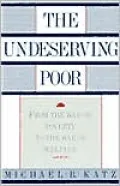
For the first time in over twenty-five years. the issue of poverty -- and our failure to deal with it -- is back at the top of the policy agenda and on the front page of the news. In this magisterial overview social historian Michael B. Katz, examines the ideas and assumptions that have shaped public policy from the sixties War on Poverty to the current war on welfare. Closely argued and lucidly written. The Undeserving Poor transcends the barriers that have channeled the American discussion of poverty and wealth into a narrow, self-defeating course, and points the way to a new, constructive approach to our major social problem.A social historian examines the ideas and assumptions that have shaped public policy from Johnson's war on poverty to Reagan's war on welfare.
Editorials
Publishers Weekly -
Katz ( In the Shadow of the Poorhouse: A Social History of Welfare in America ) here meticulously fashions a battery of statistics into a cogent rebuttal to the ``culture of poverty'' theory--the idea that poverty is inherited and transmitted in the form of cultural maladaptations (such as what LBJ termed ``the breakdown of the Negro family structure''). Katz persuades that this patronizing paradigm ``offered the poor social work and therapy when they needed economic justice and political mobilization.'' Instead, argues Katz, economic stagnation, a disproportionate rise in low-paying jobs and a declining minimum wage have exacerbated urban poverty. He deconstructs the ``underclass'' and the age-old categorization of the poor into ``deserving'' (e.g., widows) and ``undeserving'' ('80s welfare mothers), and concludes that domestic poverty has ``always . . . been a necessary result of America's distinctive political economy.'' (Jan.)Library Journal
Buttressing his analysis with excerpts from other prominent social and political observers, Katz traces the U.S. government's political and financial policies vis-a-vis the least affluent U.S. citizens from the 1960s through the Reagan administration. He argues that the overwhelming tendency historically has been to identify ``the poor'' as a culturally defined sub-unit of society, lacking ambition and moral standards, undeserving recipients of public assistance. Stereotyping has obscured evaluation of the control and distribution of political and economic power in America, and of the overall community benefit were every individual to be assured the minimum condition of human dignity at least in the economic sphere. A thoughtful work for academics and professionals.-- Suzanne W. Wood, SUNY Coll. of Technology, AlfredBook Details
Published
June 13, 1990
Publisher
Knopf Doubleday Publishing Group
Pages
304
Format
Paperback
ISBN
9780679725619