
Americas - Diplomatic Relations with the U.S., 20th Century American History - Relations - General & Miscellaneous, U.S. Politics & Government - 1992-2001, Cuba - Politics & Government, 20th Century American History - Cold War, Latin America - Diplomatic
Available on Bookshop
Write a review
Books.org participates in affiliate programs including Bookshop.org and the Amazon Services LLC Associates Program. We may earn a commission from qualifying purchases made through links on this page, at no additional cost to you.
Log in to track your reading progress.
Overview
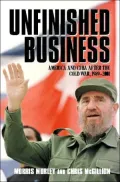
In this first comprehensive study of U.S. policy toward Cuba in the post-Cold War era, Morris Morley and Chris McGillion draw on interviews with Bush and Clinton policymakers, congressional participants in the policy debate, and leaders of the anti-sanctions business community to argue that Bush and Clinton operated within the same Cold War framework that shaped the Cuba policy of their predecessors. They also demonstrate that U.S. policy after 1989 was driven principally by domestic imperatives. The result was the pursuit of a policy that had nothing to do with its stated objectives of promoting reforms in Cuba and everything to do with dismantling Castro's regime. This study also addresses the international consequences: the extraterritorial applications of national laws to America's allies; and a willingness to put in danger the operations of the global free trade regime. Few issues more starkly revealed the degree to which U.S. policymakers exhibited a striking lack of realism about America's capacity to impose its will globally. Morris Morley has taught at SUNY-Binghamton and American Unversity. He is the author of Imperial State and Revolution (Cambridge, 1987) and Washington, Somoza and the Sandanistas (Cambridge, 1994) He is a senior research fellow with the Council on Hemispheric Affairs. Chris McGillion has taught at the Universities of Sydney and New South Wales, and Macquarie University. He is a former editorial page editor of the Sydney Morning Herald and has written for the Political Science Quarterly. As a journalist, he has made several trips to Cuba.Editorials
From the Publisher
"This excellent book exhaustively examines the relationship between domestic policy and foreign policy. The influence of one over the other is amply illustrated--in this case, the major role played by the Cuban-American National Foundation ... in influencing policy toward Cuba.... Highly recommended." Choice"...Morley and McGillion provide a complete review of US-Cuba relations in the last decade... they also provide insightful commentary on the contradictory, disaster-prone, and counter-productive measures taken by the Washington establishment." The International History Review
"A worthwhile and recommended read." H-DIPLO
Book Details
Published
September 16, 2002
Publisher
Cambridge ; Cambridge University Press, 2002.
Pages
264
Format
Paperback
ISBN
9780521520409