
Algebra, Geometry - Algebraic, History of Mathematics
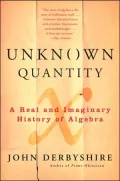
Available on Bookshop
Write a review
Books.org participates in affiliate programs including Bookshop.org and the Amazon Services LLC Associates Program. We may earn a commission from qualifying purchases made through links on this page, at no additional cost to you.
Log in to track your reading progress.
Overview
Prime Obsession taught us not to be afraid to put the math in a math book. Unknown Quantity heeds the lesson well. So grab your graphing calculators, slip out the slide rules, and buckle up! John Derbyshire is introducing us to algebra through the ages -- and it promises to be just what his die-hard fans have been waiting for. "Here is the story of algebra." With this deceptively simple introduction, we begin our journey. Flanked by formulae, shadowed by roots and radicals, escorted by an expert who navigates unerringly on our behalf, we are guaranteed safe passage through even the most treacherous mathematical terrain. Our first encounter with algebraic arithmetic takes us back 38 centuries to the time of Abraham and Isaac, Jacob and Joseph, Ur and Haran, Sodom and Gomorrah. Moving deftly from Abel's proof to the higher levels of abstraction developed by Galois, we are eventually introduced to what algebraists have been focusing on during the last century. As we travel through the ages, it becomes apparent that the invention of algebra was more than the start of a specific discipline of mathematics -- it was also the birth of a new way of thinking that clarified both basic numeric concepts as well as our perception of the world around us. Algebraists broke new ground when they discarded the simple search for solutions to equations and concentrated instead on abstract groups. This dramatic shift in thinking revolutionized mathematics. Written for those among us who are unencumbered by a fear of formulae, Unknown Quantity delivers on its promise to present a history of algebra. Astonishing in its bold presentation of the math and graced with narrative authority, our journey through the world of algebra is at once intellectually satisfying and pleasantly challenging.Editorials
From Barnes & Noble
In Unknown Quantity, John Derbyshire sets out to construct an accessible survey of algebra's development over 3,000 years. With a keen sense of readers' fear of formulas, he navigates a path from Sumerian and Babylonian clay bookkeeping to the manifolds used by Andrew Wiles to solve Fermat's Last Theorem.American Scientist
A reader who wants to learn some theory of equations and modern algebra in a relatively painless way will find this book attractive. The explanations of many algebraic topics are accessible and clear, especially those of the following: how Vieta's new general symbolic notation demonstrates the relations between roots and coefficients of polynomials; symmetric polynomials and solvability; the roots of unity; how Paolo Ruffini's proof of the unsolvability of the quintic worked; how studying permutations of roots of polynomial equations gave rise to group theory; how linear transformations and matrices are related; the nature of quaternions and octonions; what an invariant is; an introduction to algebraic geometry; what a vector space is; and what the differences are between groups, division rings and fields. Those explanations also make clear why mathematicians cared about these problems and how these concepts were used. The anecdotes...certainly make the book fun to read. -- Judith V. GrabinerThe story of algebra is the story of civilization itself. Unknown Quantity buzzes with rivalries, frustrations, and breakthroughs ... a first-rate account.
This book's title is deceiving, for Derbyshire offers a very real and very entertaining survey of the development of algebra. "Real" and "imaginary" refer to types of numbers, and Derbyshire (Prime Obsession) opens with a basic primer on the various flavors of numbers and polynomials before looking at algebra's development over 3,000 years. As he explains how algebraic notation wended its way from Sumerian scratches on clay to such contemporary mathematical structures as Calabi-Yau manifolds (used by Andrew Wiles to solve Fermat's Last Theorem), Derbyshire introduces readers to the colorful figures who made contributions: Hypatia, whose death in Alexandria at the hands of an angry Christian mob marked the end of mathematics in the ancient world; 19th-century mathematician Hermann Grassmann, who published a 3,000-page translation of the ancient Hindu text the Rig Veda after his work on vector spaces was ignored; and Emanuel Lasker, more famous as the longest-reigning world chess champion than for his contributions to ring theory. This book will appeal to readers who relished the rigorous mathematical discursions interspersed with informal historical vignettes of David Berlinski's A Tour of the Calculus, but less mathematically inclined readers more interested in the history of science will also enjoy it. (May) Copyright 2006 Reed Business Information.
National Review columnist Derbyshire follows up Prime Obsession with a similar book on the historical development of algebraic principles. As a mathematician, linguist, systems analyst, and critic, he interweaves historical insight and biographical sketches into a book that is both compelling and easy to follow. The story line delves into algebraic principles concentrating on mathematical abstractions, historical narratives, and the development of mathematical ideas. Derbyshire moves quickly through the contributions of select mathematicians (not a complete who's who in algebra), including Diophantus, Descartes, Bernhard Riemann, and David Hilbert. The text-complete with mathematical primers, solved problems, figures, and historical vignettes-is written at a high school level for a general audience interested in recreational mathematics. Recommended for all school and public libraries and mainly undergraduate academic libraries.-Ian Gordon, Brock Univ. Lib., St. Catharines, Ont. Copyright 2006 Reed Business Information.
Book Details
Published
May 29, 2007
Publisher
Penguin Group (USA) Incorporated
Pages
416
Format
Paperback, 2007
ISBN
9780452288539