
Administration & Management, Applied Science, Science - Applied, General & Miscellaneous Military History, World War II, Ethics & Moral Philosophy
Available on Bookshop
Write a review
Books.org participates in affiliate programs including Bookshop.org and the Amazon Services LLC Associates Program. We may earn a commission from qualifying purchases made through links on this page, at no additional cost to you.
Log in to track your reading progress.
Overview
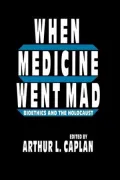
In When Medicine Went Mad, one of the nation's leading bioethicists-and an extraordinary panel of experts and concentration camp survivors-examine problems first raised by Nazi medical experimentation that remain difficult and relevant even today. The importance of these issues to contemporary bioethical disputes-particularly in the thorny areas of medical genetics, human experimentation, and euthanasia-are explored in detail and with sensitivity.
Synopsis
In When Medicine Went Mad, one of the nation's leading bioethicists-and an extraordinary panel of experts and concentration camp survivors-examine problems first raised by Nazi medical experimentation that remain difficult and relevant even today. The importance of these issues to contemporary bioethical disputes-particularly in the thorny areas of medical genetics, human experimentation, and euthanasia-are explored in detail and with sensitivity.Editorials
Publishers Weekly -
The Nazis performed monstrous biomedical experiments on concentration camp prisoners, compiling racial and other information while slowly killing them. Should the data from these experiments be banned, or mined for their possible potential benefit? This set of papers from a 1989 symposium at the University of Minnesota (where Caplan directs the Center for Biomedical Ethics) opens with the testimonies of camp survivors, who urge that the data be shredded. Another contributor argues that the data are scientifically worthless; others agonize over the issue and conclude that the Nazi data ought to be published. Of broader interest is an essay showing how the science of racial hygiene, which supported forced sterilization of undesirable racial groups, among other policies, took hold in Germany long before the Nazis came to power. One contributor compares Nazi euthanasia to the current practice of withdrawing life-support systems from patients whose continued treatment is not ``costworthy.'' The closing paper thoughtfully looks at ethical dilemmas surrounding the Human Genome Project, an attempt to map human genes which, critics charge, could open the door to Nazi-like abuses. (Sept.)Library Journal
Despite its fiery and garish title, When Medicine Went Mad is a sober and scholarly analysis of the Nazi physicians who--in the name of science--carried out unspeakable atrocities upon countless victims. Caplan, a national leader in bioethics, has assembled outstanding experts on the subject, including actual research subjects of this ghastly experimentation. Contributors include well-known bioethicists such as George Annas, Ronald Cranford, Benjamin Freedman, Jay Katz, Ruth Macklin, and Caplan himself. Personal testimonies by Eva Kor, Susan Vigorito, and Gisela Konopka are particularly meaningful, forming an ideal background for vexing questions about why these atrocities happened and how to insure that they never recur. Of particular value to researchers are the essays by Katz and Annas, who boldly confront the implications of Nazi medicine for today's research into the Human Genome and various other fields of study. Recommended for academic and medical school libraries.-- David A. Buehler, Charlton Memorial Hosp., Fall River, Mass.Book Details
Published
December 31, 2012
Publisher
Springer-Verlag New York, LLC
Pages
371
Format
Paperback
ISBN
9781461267515