
Hispanic Americans - Fiction & Literature, Historical Figures - Fiction, Thrillers, Occupations - Fiction, Historical Fiction, Character Types - Fiction
Log in to track your reading progress.
Overview
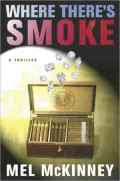
A lovesick expatriate Cuban, an unscrupulous Southern capitalist, and a sanitized Mafia heir scratching a mid-life itch come together in this barbed tale centered around a cache of Cuban cigars secured for JFK just before he tightened the embargo in 1963. Mel McKinney’s Where There’s Smoke is an ironic, provocative, and action-packed ride that hurtles full-force toward a breathless conclusion.
Editorials
Publishers Weekly -
This audacious foray into Elmore Leonard/Donald Westlake literary territory begins in Cuba in 1955, when American mafioso Don Bonafaccio decides to "make an example" of Victor Salazar, the embezzling owner of a Mafia-controlled Havana nightclub. Victor is killed, but his son Raul is spared and allowed to flee to America with just $1000. Eight years later, Raul is the owner of his own nightclub in Miami. After an encounter with two patrons, freshman Republican congressman Wesley Trent Cameron and Cameron's cigar-loving, rich father-in-law Cornelius Gessleman, Raul glimpses the outline of a perfect con, one that will make him enough money to rejoin his love, Rosa Solero, in Cuba, and help out with the revolution at the same time. He persuades the congressman to finance a plan whereby Raul will steal 1000 cigars from President Kennedy's private stock, which Cameron, who is eager to prove his mettle, can present to Gessleman. After JFK is killed, Raul contacts the pair to advise them of his successful theft. He also mentions that he was able to pull off the job due to a "distraction" he created--i.e., the assassination. Seeing a chance to make more money, Raul blackmails Cameron and Gessleman. Meanwhile, Joseph Bonafaccio Jr. discovers a long-kept secret: Victor Salazar took the money he embezzled and turned it into diamonds rolled in three boxes worth of cigars made by Grandfather Jennaro Salazar. The cigars, which were briefly in President Kennedy's possession, now sit in a motel room in Massachusetts. Raul, tailed by a Bonafaccio hit man hired by Gessleman, learns the story of the diamonds, and an elaborate chase ensues. The plot is sometimes slowed by ponderous flashbacks, but McKinney's tale of crime and revenge features an appealing set of quirky eccentrics and the perfect denouement for a comedic crime novel. (Oct.) Copyright 1999 Cahners Business Information.Library Journal
Although McKinney begins with an interesting premise, his first novel soon devolves into a typical tale of trickery and deception, with an inordinate number of esoteric cigar references thrown in. The story begins in mid-1963 and centers on 1000 Cuban cigars that JFK has ordered for his personal collection shortly before placing an embargo on all things Cuban. When the cigars are stolen, a complicated tale of multigenerational revenge unfolds, taking the reader from Cuba to Miami to Hyannisport and somehow attaching the theft of said cigars to Kennedy's eventual assassination. While McKinney shows a deft touch in writing about family relationships, the story often seems disorganized, and he too often allows cigars to move from a complementary role in the tale to one of prominence. Overall, this is a rather disappointing effort, especially since the story shows promise in its early stages. Recommended only for large general fiction collections.--Craig L. Shufelt, Lane P.L., Hamilton, OH Copyright 1999 Cahners Business Information.Kirkus Reviews
Newcomer McKinney embroiders a gossamer criminal fantasy on a single historical fact: President Kennedy's purchase of 1,100 Cuban cigars the night before he ordered the embargo of Cuba in July 1963. What ever became of those cigars when the president was assassinated four months later? McKinney's giddy but logical premise is that they were stolen to sell to political kingmaker Cornelius Gessleman, who agreed to pay Raul Salazar $20,000 to create a diversion that would allow his team to break into Kennedy's Cape Cod complex. Gessleman's horrified when he hears Salazar talk blandly of how the "diversion" his men settled on in Dallas drove up the price of the theft because, accustomed to dealing with toadies and fools like his son-in-law, Rep. Wesley Cameron (R-Fla.), he doesn't recognize a bluff when he hears one. Nor is he capable of seeing that Salazar, having extracted a whopping premium for the cigars Gessleman had coveted, is planning to swindle him out of them—partly because Salazar, driven out of Cuba years ago by his tobacco-growing father's silent partners, the Bonafaccio family, has continued to regard the cigars as his own; partly because an unexpected twist has suddenly made them much more valuable; and partly because Salazar, who gradually emerges as the novel's hero, gets an energizing joy from scamming his enemies. Since those enemies, from petty Gessleman to brutal mob scion Joseph Bonafaccio, Jr., keep coming back for more, and since even the most minor functionaries, from the thugs Salazar sent to boost the cigars to the Yankee constable on their trail, are working their own angles, McKinney is able to keep his pot merrily bubbling long after you've lost trackof who's double-crossing whom. The wildly far-fetched plot has its own internal logic, sharpened at every possible moment by the pungent aroma of fine cigars.Book Details
Published
April 1, 2011
Publisher
St. Martin's Press
Pages
224
Format
Hardcover
ISBN
9781429977814