
Literary Criticism - General & Miscellaneous, 20th Century American Literature - General & Miscellaneous - Literary Criticism, Women Authors - American (U.S.) - Literary Criticism, 20th Century American Literature - Pre WWII - Literary Criticism
Available on Bookshop
Write a review
Books.org participates in affiliate programs including Bookshop.org and the Amazon Services LLC Associates Program. We may earn a commission from qualifying purchases made through links on this page, at no additional cost to you.
Log in to track your reading progress.
Synopsis
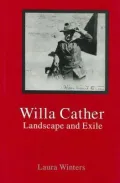
This is a work about the ways in which Willa Cather transforms secular space into sacred places in her fiction. She uses landscape not merely as a backdrop against which her characters struggle, but as a character in and of itself - a dynamic presence. For her, landscape is like consciousness, surrounding us always. In her novels, Cather describes the ways in which places allow people to understand their authentic selves. Cather's characters are intricately connected to the places they inhabit. Bartley Alexander cannot be fully understood apart from the kind of bridges he constructs, nor Marian Forrester apart from her bedroom; nor Godfrey St. Peter apart from his houses; nor Myra Henshawe apart from the cliff to which she travels in order to die; nor Father Latour apart from the cathedral he builds and the cave he visits; nor Cecile and Euclide Auclair apart from their home nestled into the rock of Quebec. Each of these characters makes a place of exile his or her own. Cather's artistic voice speaks for and through the landscapes she loved in life. As several critics have noted, Cather's mind works by opposition, furiously spinning doubles of character, experience, temperament, and place. Locating the scenes she imagines in particular places, she forces her readers to merge character and place in a way no other American writer has ever done. Willa Cather's fiction is also suffused with the notion of exile. Her characters, often banished from a native or authentic landscape, are restless pilgrims who long for home - a comforting space, a rest from the arduous journey. In order to manage the condition of exile, Cather's characters must transform secular spaces into sacred places. In these sacred places, existence suddenly makes sense: order is created from chaos, as the history of the earth and the history of the individual merge and are reconciled. Indeed, these sacred places, with an aura of resolution and rightness in their very air, bring peace. In this volume, Laura Winters presents and explains the metaphors of cantilever and suspension in Cather's first novel, Alexander's Bridge. She addresses Cather's parable of inspiration lost and found in A Lost Lady. She also deals with the pervasiveness of possession in Cather's fiction - particularly with how this pervasiveness is worked out in relation to landscape in The Professor's House. Cather's description of death in exile as presented in My Mortal Enemy and her play with movement and stasis in Death Comes for the Archbishop are also treated. Finally Winters discusses the condition of exile in Shadows on the Rock.Book Details
Published
January 1, 1994
Publisher
Susquehanna University Press
Pages
127
Format
Hardcover
ISBN
9780945636564