
Join Books.org — it's free

Paleontology - General & Miscellaneous, Fossils, Paleontology - Geological Time Periods, Zoology - Vertebrates & Invertibrates, Philosophy - General & Miscellaneous
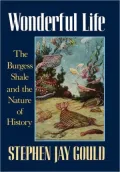
Wonderful Life by Sj Gould β€” book cover

Wonderful Life

by Sj Gould
Available on Bookshop Write a review

Books.org participates in affiliate programs including Bookshop.org and the Amazon Services LLC Associates Program. We may earn a commission from qualifying purchases made through links on this page, at no additional cost to you.

Log in to track your reading progress.

Overview

High in the Canadian Rockies is a small limestone quarry formed 530 million years ago called the Burgess Shale. It hold the remains of an ancient sea where dozens of strange creatures lived"a forgotten corner of evolution preserved in awesome detail. In this book Stephen Jay Gould explores what the Burgess Shale tells us about evolution and the nature of history.

"Luminous. . .Filled with profound and upsetting ideas like the Burgess Shale itself and just as solid. It is surely one of nature's best stories, told with a light touce by a master of the field."--Lewis Thomas, M.D.

About the Author, Sj Gould

Stephen Jay Gould (1941-2002) was the Alexander Agassiz Professor of Zoology and Professor of Geology at Harvard University. He published over twenty books, received the National Book and National Book Critics Circle Awards, and a MacArthur Fellowship.

Biography

Harvard paleontologist Stephen Jay Gould was arguably the leading science writer for the contemporary literate popular audience. His explications of evolutionary theory and the history of science are peppered with oddball cultural and historical references, from Joe DiMaggio's hitting streak to Catherine the Great's middle name. But Gould insisted that his work wasn't dumbed-down for nonscientists.

"I sort of operate at one end of what's called popular science," he told a Salon interviewer. "Not because I don't appreciate the other end, I just wouldn't do it well, somehow. But the end I operate on really doesn't sacrifice any complexity -- except complexity of language, of course, complexity of jargon. But I like to think that my stuff is as conceptually complex as I would know how to write it for professional audiences."

In 1972, Gould and fellow paleontologist Niles Eldredge shook up the field of evolutionary theory with their idea of "punctuated equilibrium," which suggests that the evolution of a species is not gradual and continual, but marked by long periods of stasis and brief bursts of change. Over the next several decades, Gould would continue to develop his critique of evolutionary theory, questioning assumptions about evolutionary progress and provoking debates with the likes of evolutionary psychologist Steven Pinker, philosopher Daniel Dennett and evolutionary biologist Richard Dawkins.

From early on in his career, Gould was interested in reviving the scientific essay, in the tradition of Galileo and Darwin. Gould began writing a series of monthly essays for Natural History, the magazine of the American Museum of Natural History. Published as "This View of Life," the well-received essays addressed a broad range of topics in the biological and geological sciences. In his essays, Gould not only explained scientific facts for the lay reader, he critiqued the shortcomings of certain scientific viewpoints and the cultural biases of particular scientists.

Armed with a historical view of evolutionary theory, he tackled the problem of human intelligence testing in The Mismeasure of Man (1981). The book won a National Book Critics' Circle Award, while a collection of essays, The Panda's Thumb (1980), won the American Book Award. Together the books established Gould's presence as one of the country's most prominent science writers.

Gould's popularity continued to widen with the publication of such unlikely bestsellers as Wonderful Life: The Burgess Shale and the Nature of History (1989), which challenged the notion that humans are the necessary endpoint of evolutionary history. "Not only does [Gould] always find something worth saying, he finds some of the most original ways of saying it," The New York Times said in its review of Bully for Brontosaurus (1993), another collection of essays.

In 1998, Gould was elected president of the American Association for the Advancement of Science, and his description of that office could apply to his whole life's work. He pledged to "make people less scared of science so they won't see it as arcane, monolithic, and distant, but as something that is important to their lives." Stephen Jay Gould died in May of 2002 of cancer.

Good To Know

In a Mother Jones interview, Gould mentioned that he was teased as a child for his fascination with paleontology. The other kids called him "fossil face." Gould added, "The only time I ever got beat up was when I admitted to being a Yankee fan in Brooklyn. That was kind of dumb."

Gould was diagnosed in 1982 with abdominal mesothelioma, a rare form of cancer. In one of his most famous essays, "The Median Isn't the Message," he explained how statistics are often misinterpreted by nonscientists, and why the grim statistics on his own disease -- with a median mortality of eight months, at that time -- didn't deter him from believing he would live for many more years. "[D]eath is the ultimate enemy -- and I find nothing reproachable in those who rage mightily against the dying of the light," he wrote. He died in May 2002 -- 20 years after his diagnosis.

Gould made a guest appearance as himself on The Simpsons in 1997, participating in a town debate over the authenticity of an "angel skeleton" found in Springfield.

Reviews

There are no reviews yet. Log in to write one.

Editorials

Walter C. Sweet - Science

β€œGould at his best. . . . The message of history is superbly conveyed. . . . Recommended reading for scientists and nonscientists of all persuasions.”

Lewis Thomas

β€œLuminous. . . . Filled with profound and upsetting ideas like the Burgess Shale itself and just as solid. It is surely one of nature's best stories, told with a light touch by a master of the field.”

Richard A. Fortey - Nature

β€œThere is no question about the historical importance of the Burgess Shale, and Gould is right when he says that it deserves a place in the public consciousness along with big bangs and black holes. . . . A compelling story, told with characteristic verve.”

James Gleick

Mr. Gould is an exceptional combination of scientist and science writer, one of America's foremost paleontologists and the author of many books on evolution and on scientific history. He is thus exceptionally well placed to tell these stories, and he tells them with fervor and intelligence. He attempts a rare thing in science writing: a book meant to hold the interest of both specialists and lay readers....Mr. Gould revels in both the big and the small, and he weaves his stories together well. -- New York Times

Publishers Weekly - Publisher's Weekly

The Burgess Shale, a small quarry in the mountains of British Columbia, opened a window on the first multicellular animals. Gould, eminent life-historian and author, introduces us to the creatures of Burgess Shale and to those who have painstakingly examined them. ``This is exciting and illuminating material on the beginnings of life,'' wrote PW. Illustrated. (Sept.)

Library Journal

The Burgess Shale, found in the Canadian Rockies, contains an extremely important fossil fauna that includes an assortment of weird and wonderful creatures. Gould, the best-known modern exponent of paleontology and evolutionary biology, interprets, with the wit and grace his many fans expect, the significance of this 530-million-year-old fauna. His arguments entail learning some anatomy of unfamiliar creatures, but Gould gently guides the way. The book does ramble some, but the asides are so fascinating! This book is much more theoretical than Harry B. Whittington's briefer and more matter-of-fact work, The Burgess Shale (Yale Univ. Pr., 1985), another good book on the topic. This is an intellectual delight, one of Gould's best recent books. It is highly recommended for the interested layperson, as well as for students from the college level on up. BOMC, History Book Club, and Quality Paperback selections. Previewed in Prepub Alert, LJ 5/1/89.-- Joseph Hannibal, Cleveland Museum of Natural History

Book Details

Published
November 22, 1989
Publisher
New York : W.W. Norton, c1989.
Pages
348
Format
Hardcover
ISBN
9780393027051

More by Sj Gould

Similar books