
Teaching - English Language, Writing - General & Miscellaneous, Teaching - Curricula, Technical Writing, Rhetoric - English Language, Nursing Issues
Log in to track your reading progress.
Editorials
From The Critics
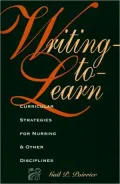
Reviewer: Mary Boose Walker, EdD, RN(Widener University School of Nursing)Description: This book chronicles the Writing-to-Learn curriculum paradigm as implemented by nursing faculty at Southwestern Louisiana University. Several contributing authors present a compilation of strategies for improving student learning outcomes by writing, plus improvement of teaching effectiveness, professional growth, research, and communication skills.
Purpose: The purpose is to provide a practical resource for implementation of the Writing-to-Learn curriculum and to share success stories from nursing, so other nursing faculty and faculty of other health disciplines can benefit, and to assist students achieve learning goals in nursing practice, reflective critical thinking, and communication skills. This valuable resource met its overall objective of offering a model for educational change.
Audience: The author's stated target audience is faculty in nursing and other disciplines. The primary author is a credible authority.
Features: Multiple current books and periodicals are listed as references. The table of contents and index are well organized and adequate. The book is easy to read. Individual chapters have a cover page that reinforces the "how-to" strategy of each chapter, following the author's theoretical presentation.
Assessment: This persuasively written book makes a valuable contribution. It is a thought-provoking guide for any nursing faculty who desires to improve teaching effectiveness and student outcomes. It is important for meeting demands for new outcome-based accreditation criteria and public accountability. The book takes the reader through theory, implementation of successful writing strategies for promoting critical thinking (e.g., journal writing, unsent letters, articles meant for publication) and for development of student understanding of professional accountability through reflective writing. Emphasis is on written language as a lifelong learning tool for enhancing communication, changing faculty perceptions of writing, developing undergraduate student analytical thinking, and communicating with consumers and the discipline. Stories told are wise, evaluative, and practical, emphasizing the power of written language.
Mary Boose Walker
This book chronicles the Writing-to-Learn curriculum paradigm as implemented by nursing faculty at Southwestern Louisiana University. Several contributing authors present a compilation of strategies for improving student learning outcomes by writing, plus improvement of teaching effectiveness, professional growth, research, and communication skills. The purpose is to provide a practical resource for implementation of the Writing-to-Learn curriculum and to share success stories from nursing, so other nursing faculty and faculty of other health disciplines can benefit, and to assist students achieve learning goals in nursing practice, reflective critical thinking, and communication skills. This valuable resource met its overall objective of offering a model for educational change. The author's stated target audience is faculty in nursing and other disciplines. The primary author is a credible authority. Multiple current books and periodicals are listed as references. The table of contents and index are well organized and adequate. The book is easy to read. Individual chapters have a cover page that reinforces the "how-to" strategy of each chapter, following the author's theoretical presentation. This persuasively written book makes a valuable contribution. It is a thought-provoking guide for any nursing faculty who desires to improve teaching effectiveness and student outcomes. It is important for meeting demands for new outcome-based accreditation criteria and public accountability. The book takes the reader through theory, implementation of successful writing strategies for promoting critical thinking (e.g., journal writing, unsent letters, articles meant for publication) and fordevelopment of student understanding of professional accountability through reflective writing. Emphasis is on written language as a lifelong learning tool for enhancing communication, changing faculty perceptions of writing, developing undergraduate student analytical thinking, and communicating with consumers and the discipline. Stories told are wise, evaluative, and practical, emphasizing the power of written language.5 Stars! from Doody
Book Details
Published
January 1, 1997
Publisher
New York : National League for Nursing, 1996.
Pages
208
Format
Paperback
ISBN
9780887377235