
Poetry - Assorted Topics, Children - Animals
Log in to track your reading progress.
Overview
Have you ever seen a yellow elephant, glowing in the jungle sun?Have you seen a green frog--splash!--turn blue?
Or a red donkey throw a red-hot tantrum?
In this bright bestiary, poet Julie Larios and painter Julie Paschkis cast a menagerie of animals in brilliantly unexpected hues--encouraging us to see the familiar in surprising new ways.
Editorials
Publishers Weekly
Playful, whimsical images abound in Larios's (Have You Ever Done That?) 14 animal-themed poems, all delightfully realized in Paschkis's (Through Georgia's Eyes, reviewed Feb. 20) exuberant paintings. As the collection's title indicates, the animals each get an assigned color, some ordinary (Gold Finch, Brown Mouse), others extraordinary (Purple Puppy, Pink Cat). Still others transform unexpectedly (for the Green Frog, "One hop/ and her green/ is gone./ See how she swims,/ blue frog now/ under blue water"). Every poem gets a full-page illustration and a handsome, visually linked decorative panel. Swirling shapes offset geometric patterns to harmonious effect. Paschkis's exquisitely balanced painting for "Green Frog" renders a serene metamorphosis, as the frog takes a leg-extending plunge, her legs green above the surface, and underwater she becomes blue. Smoothly combining assonance, alliteration and near rhymes, Larios creates images that invite readers' enthusiasm, as with the title poem: "Oh,/ I think no other animal can/ (I know a mosquito can't)/ glow in the jungle sun/ like a wild-eared/ yellow elephant." A dynamic, contagious energy emanates from both the poetry and the art, whether the animals take to the air, land or sea. Ages 5-10. (Apr.) Copyright 2006 Reed Business Information.Booklist
*"The poems beautifully show how color and sound create mood and imagery."
Children's Literature
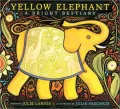
From the front cover with its sunshine-yellow elephant's blanket foreshadowing each featured character, to the departing view of the elephant at the end, Larios and Paschkis provide a lively parade of sight and sound. Each spread pairs one animal or bird in vivid gouache illustration with its matching poem. The choice of such descriptors as the "skittering" brown mouse, the "silver quiver" of the black fish, and the "high orange laugh" of the hyena, draws young readers into emotions evoked by the sounds as well as the splashes of color. This title is likely to become a favorite of novice lovers of poetry with its winning combination of animals, colors, word pictures, and near onomatopoeic expressions. Superb art perfectly reflects each poem. 2006, Harcourt, Ages 5 to 10.—Janice DeLong
School Library Journal
PreS-Gr 2-In this creative exploration of color, Paschkis's full-page gouache illustrations of animals are brimming with vibrant and unexpected hues: an orange giraffe, a pink cat, a blue turtle. Larios's poems are, for the most part, fresh offerings of alliteration, rhyme, and gentle surprises. Some pairings are more successful than others. "Red Donkey," "Silver Gull," and "Gold Finch" are the strongest, most imaginative poems in the book, with superb illustration and engaging poetic qualities. While the artwork for the surprisingly unsurprising "White Owl" is eye-catching, the poem itself doesn't hold the same charm that one finds in other verses. "Brown Mouse," too, lacks verve and whimsy. The book design is simple and effective: one page is devoted to the poem itself with words against a white background and a rectangular sidebar illustration to match the full-page picture opposite. There's no question that this is a visually stimulating and interesting book, thanks especially to Paschkis's folk art, which seems to be largely inspired by South American and African cultural styles. Not all of the poems are as strong, but the ones that rise above are a sheer delight.-Carol L. MacKay, Forestburg School Library, Alberta, Canada Copyright 2006 Reed Business Information.Kirkus Reviews
Fourteen familiar animals are the focus of this poetry collection, with each poem describing one animal's color and personality. The assigned colors are sometimes a realistic color for that animal (a brown mouse, a white owl), but more often, the particular color reflects an aspect of the creature's personality (an angry red donkey, for example, or a perky purple puppy) or the animal's surroundings (the titular yellow elephant "galumphing along" in the jungle sunshine). The poems are short, accessible and mainly non-rhyming, though many have subtle internal rhymes or a single rhyming couplet. The elegant design features the poems on the left-hand pages surrounded by white space and balanced with a small, vertical illustration of the particular animal. The right-hand pages are full-page paintings in gouache of the brilliantly colored creatures, with each animal set against a patterned background suggestive of its environment. The inventive colorations will intrigue children, who might wish to meet a pink kitty or a turquoise lizard. (Poetry. 4-8)Book Details
Published
April 1, 2006
Publisher
Houghton Mifflin Harcourt
Pages
32
ISBN
9780547546933