
Strategy & Weapons of War, United States History - 20th Century - Wars & Conflict, 1917-1991 (Soviet Union) - History, United States History - 20th Century - 1945 to 2000, Public Opinion, Cubans & Cuban Americans, U.S. Politics - History, Caribbean & West
Available on Bookshop
Write a review
Books.org participates in affiliate programs including Bookshop.org and the Amazon Services LLC Associates Program. We may earn a commission from qualifying purchases made through links on this page, at no additional cost to you.
Log in to track your reading progress.
Overview
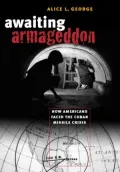
For thirteen days in October 1962, America stood at the brink of nuclear war. Nikita Khrushchev's decision to place nuclear missiles in Cuba and John F. Kennedy's defiant response introduced the possibility of unprecedented cataclysm. The immediate threat of destruction entered America's classrooms and its living rooms. Awaiting Armageddon provides the first in-depth look at this crisis as it roiled outside of government offices, where ordinary Americans realized their government was unprepared to protect either itself or its citizens from the dangers of nuclear war.During the seven days between Kennedy's announcement of a naval blockade and Khrushchev's decision to withdraw Soviet nuclear missiles from Cuba, U.S. citizens absorbed the nightmare scenario unfolding on their television sets. An estimated ten million Americans fled their homes; millions more prepared shelters at home, clearing the shelves of supermarkets and gun stores. Alice George captures the irrationality of the moment as Americans coped with dread and resignation, humor and pathos, terror and ignorance.
In her examination of the public response to the missile crisis, the author reveals cracks in the veneer of American confidence in the early years of the space age and demonstrates how the fears generated by Cold War culture blinded many Americans to the dangers of nuclear war until it was almost too late.
Editorials
Library Journal
[An] admirable social history . . . especially notable for its portrayal of how children were traumatized. . . . George skillfully demonstrates that the crisis was inflamed by the Cold War culture. . . . [A] first-rate investigation . . . Strongly recommended.Library Journal
Stern, a historian at the John F. Kennedy Presidential Library from 1977 to 1999, presents here the most significant interpretation of the 1962 Cuban Missile Crisis to date. He is the first historian to have full access to the October 16-29 tapes, from which he has drawn this account of the meetings between Kennedy and the Executive Committee of the National Security Council. Kennedy is portrayed by Stern as a cool, in-control leader who, despite the bellicose recommendations of the Joint Chiefs of Staff and other advisers, made rational diplomatic decisions aimed at avoiding the "final failure" of a nuclear war between the United States and the Soviet Union. However, Kennedy, along with his brother, Attorney General Robert Kennedy, are faulted for helping to precipitate the crisis by their anti-Castro obsession, which continued until JFK's assassination in 1963. This absorbing narrative is densely packed with information that may overwhelm the general reader, but historians and informed readers are richly rewarded by this first "interpretative narrative account" of the most dangerous Cold War confrontation. How ordinary Americans responded to the Cuban Missile Crisis is the theme of independent historian George's admirable social history, which is especially notable for its portrayal of how children were traumatized by air raid drills and other futile protective measures "[that] had little more credibility than the Easter Bunny." Many anecdotes are humorous only in hindsight-of panic buying, attempted evacuations of cities, and denial, which led to a mini-boom in private fallout shelters. George skillfully demonstrates that the crisis was inflamed by the Cold War culture, which led to a dangerous war of words between Kennedy and Khrushchev in a political setting where diplomacy was viewed as appeasement. Both of these first-rate investigations are strongly recommended for academic and larger public collections.-Karl Helicher, Upper Merion Twp. Lib., King of Prussia, PA Copyright 2003 Reed Business Information.From the Publisher
Alice George succeeds in exploring a neglected aspect of the much-studied Cuban missile crisis. By showing how the average American responded to the threat of Soviet missiles in Cuba, her book fills an important gap in the scholarly literature.(Robert A. Divine, University of Texas at Austin)Book Details
Published
July 21, 2004
Publisher
Chapel Hill : University of North Carolina Press, c2003.
Pages
264
ISBN
9780807861615